Cummins ISB Diesel Engine Running from John Whelan on Vimeo.
Just listen to that baby purr...doesn't it sound great? Cummins has won the "who makes the best medium diesel engine contest". These engines excel way beyond all others on the market. Caterpillar and Navistar collaborated with the MaxxForce design using HEUI injection and it could not keep up with emissions and those of us who still operate them are paying through the nose with repairs and labor to keep them on the road. Production has ceased for all MaxxForce diesel engines in the medium duty industry along with the latest shut down of the 9 and 10 models.
Mercedes MBE 900 engine manufacturing shut down years ago because of the same reason not being able to pass the emission standards. We still have several of these engines running in our fleet and are kept on our toes dealing with emission issues. They have a sturdy block and top end but could never keep the engine clean enough to run the way it should have in the first place. Soot and ash is everywhere causing constant driveability problems.
More reasons why my top pick is the Cummins ISB. It has the SCR system developed by Cummins engineers to reduce emissions down to Hydrogen and water. In other words zero levels of harmful oxides of nitrogen that pump directly out of diesel engine combustion chambers. Cummins uses diesel exhaust fluid to inject into a catalyst combined with the original diesel particulate filter design forcing bad emissions to it's knees. Our fleet will be nothing but Cummins ISB from here on in. There will be no guinea pig testing with us anymore with new diesel engine designs that salesman push with their over-enthusiastic promotions.
Sorry guys that's not going to work in our fleet. We've got our hands full trying to keep up with inferior diesel engines that fail constantly and pick away at our operating budget. It's easy to talk the talk but we are the ones that end up pulling our hair out for years. I would like to thank Cummins for designing the ISB diesel engine with the end user in mind. Everything that has to be serviced is easy to reach... your software is excellent and down time is minimal. Think red...Cummins red if you're thinking about buying a truck or a bus. You will keep a lot more cash in your wallet and you'll spend a lot more time on the road.
Showing posts with label cummins diesel engine. Show all posts
Showing posts with label cummins diesel engine. Show all posts
Monday, December 04, 2017


Saturday, January 03, 2015
Diesel Engine Emissions and DPF Diesel Particulat Filter Codes

If you look at this DPF diesel particulate filter you'll notice the clamps around the outside. Fortunately for all of us diesel techs this exhaust system is serviceable. The filter inside can be removed and serviced or if it's too far gone replaced. There are many shops now that have made the investment and have the equipment to clean the DPF filter properly.
The cost is about half compared to buying a pre-cleaned unit from the dealer. This is what I experience anyway... I'm not sure what the set up is at your location. The Detroit Diesel dealer has a cleaned DPF filter on the shelf for around $800.00 while the cleaning process is in two stages if it needs a 2 step melt down then the bill may run up to $500.00.
The good thing about this operation is it does not have to be done on a regular basis. Mercedes recommends every 125,000 km for a filter service. On the other hand if there is a over fueling or if the engine is using excessive amounts of oil due to a defect then the filter will plug up much faster.

The photo above shows both the MIL (malfunction indicator light) and the engine warning light illuminated. The MIL indicates there is a fault in the emissions system. This could be the DPF needs a regen or there is a lack of air flow in the intake system or numerous other problems. Most times we have found that the DPF regen is the most common service procedure.
With the laptop we do a forced regen and this cleans out the DPF filter using heat and diesel injection (Mercedes) or DEF (diesel exhaust fluid) for Cummins 2010 and newer engines. The DOC or diesel oxidation catalyst built into the DPF causes the chemical reaction to take place breaking down the soot and ash that builds up in the filter.
Cummins has taken it one step further with the SCR (selective catalytic reduction) process using DEF to reduce emissions even further. Low ash engine oil and low sulfur diesel fuel has also contributed to reducing emissions. If you have anything to add please do so below in the comments section. What do you think of the emissions in today's diesel engines?
Friday, December 05, 2014
Cummins Diesel Engine Training
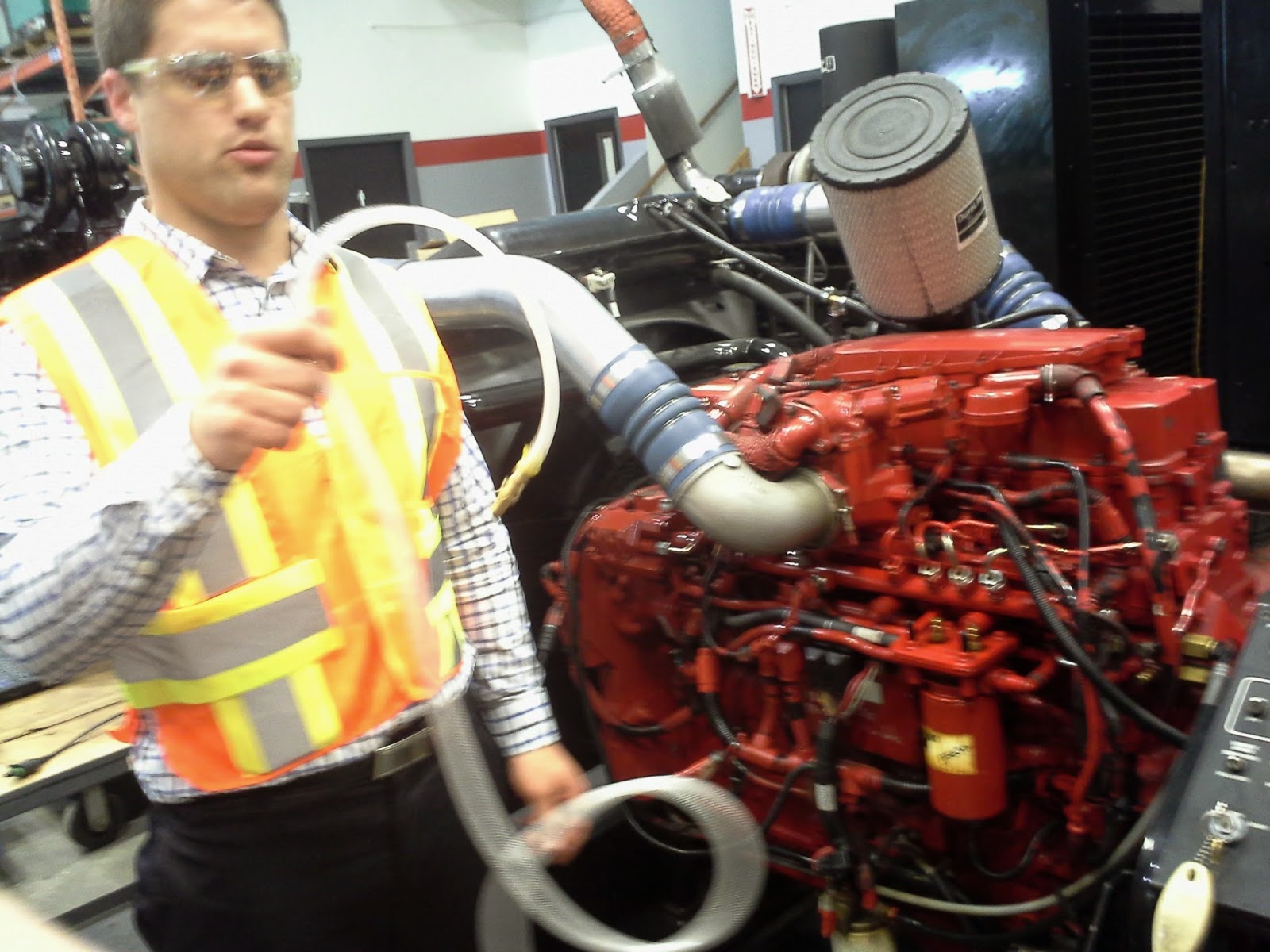

They have designed their own emission system including selective catalytic reduction and DPF (diesel particulate filter). Getting the emission levels down to EPA levels is a huge challenge. Cummins is reducing 90% of harmful exhaust out of the pipe. We own 9 of the ISBs and getting 10 more next year.
The support from our local dealer is very good which was one of the factors we looked at but I know even if the support wasn't there this would have been the engine of choice regardless. Having 'Insite Lite' software is a "must have" and without it you're sunk. Throwing parts at a problem and guessing what's wrong will cost you a ton of cash.
Another part of the ISB is the VGT (variable geometry turbocharger). Providing boost pressure for engine power is only one of the uses for this component. It also serves as the exhaust brake and helps heat up the engine during a parked regeneration. The angle of the turbo changes to cause the restriction needed.
Not only did we have classroom training but also went out and did a lot of hands on training using the Insite Lite software. The tests you can run with this software is endless. Gone are the days when you had to crack an injection line to look for a miss. Now it's all on the software with the click of a button.
For technical information there is Quickserve Online where you can find parts and manuals to help out with repairs. A manual is essential and without it you are taking a chance of screwing up the job. Information is like gold to a mechanic having the proper schematics, torque specs and step by step instructions.
I recommend anyone working steady on the ISB 6.7 or any Cummins engine needs to go get a Cummins training refresher. There you can ask questions and get the right training so you can dive into any repair with confidence. These days without a laptop on your toolbox with the proper software is like living in the stone age.
Tuesday, November 29, 2011
Mechanic Checks For Winter Operation

Coolant Testing the coolant is of course very important and changing the coolant and thermostats should also be considered. Cummins promotes DCA (dry chemical additive) checks, to make sure the system is not overcharged or undercharged. DCA prevents liner pitting by reducing air bubbles forming in the cooling jackets. Changing the coolant (non lifetime brands) with the thermostats every 2-3 years isn't a bad idea since coolant eventually breaks down and the acidic build up that forms starts to eat up gaskets and castings.
Belts and Hoses who doesn't know the importance of these bad boys. They get the most abuse from constant tension, heat produced from driving the belts and hot/cold temperatures on the hoses. I always say "when in doubt change it out". Pulley bearings and belt tensioners need to be checked out and the cooling system should be pressure tested. School buses have 1 inch cooling lines throughout the bus interior and need to be observed for leaks and loose clamps.
Batteries batteries can either be load tested once a year preferably in the fall or changed when needed. Sometimes the latter happens at the most inconvenient time when it's cold, wind blowing ....a spare bus (in my case) needs to be fired up from a cold condition. So we generally do the yearly load test and go from there deciding what step to take next.
Block Heaters Most buses in our fleet have the conventional block heater system. Our plug-ins are timed in cycles to come on during certain ambient temperatures. We test them at every service to stay on top of 'no start' conditions in the cold. A couple dozen of our newer buses have diesel heaters that have timers so they come on a couple of hours before the run.
Tune Ups Mechanics know the advantage of keeping an engine tuned up. Easier starts less fuel burned is the main objective. Valve sets, fuel filters and air filters are all you can really do to a diesel engine especially with newer models. Checking for engine codes doesn't hurt, some codes do not light up on the dash and become inactive. Common sense helps in this area of maintenance and needs to be applied looking at everything that makes a highway vehicle function. The regular Mechanic or the 'Mechanic in you' can figure this stuff out.
Monday, October 31, 2011
Diesel Mechanic's Favorite Diesel Engine
This a rather boring video but just listen to that diesel engine purr! Sit back with your favorite beverage and enjoy... The Cummins C Diesel engine 250 HP running in one of our pusher school buses (early nineties model). This engine is one of my favorites in the fleet, one reason is it's mechanical fuel injection. For the Mechanic... much easier to work on compared to today's units.
I had one of the Mechanics from the Cummins dealership ask me if any of our buses with this engine model were coming due for auction, he was interested in picking one up because of the non-electronic fuel injection system. These are popular models mainly because of the basic mechanics involved when working on them. The Bosch fuel injection pump is straight forward and works off a mechanical linkage operated by an air throttle pedal. The fuel shutdown is controlled by relays and is a very basic hard wired electrical system.
I know I'm dating myself here but electronics just needs a wisp of condensation and you're going to end up with some trouble. The precise technology of today is amazing stuff and controlling operating systems with printed circuits can't be beat compared to older technology but I sure miss it. Let's just say for all of us modern Mechanics you've got to stay sharp!
Subscribe to:
Posts
(
Atom
)