Friday, December 31, 2010

Valve Adjustment On A DT466E International Diesel Engine

DIESEL MECHANIC - How To Adjust Valves On An International DT 466E Diesel Engine


The DT 466E diesel engine is the electronic version of the former DT 466. This an engine we diesel mechanics all know and love since they are virtually almost bulletproof with a fantastic performance record. With emissions standards here to stay International has followed the other engine manufacturers and engineered electronic injection into their design.

The hardest part about working on these diesel engines is getting to the components, especially the valves if it's time for adjustment. The air to air piping has to be removed as well as the doghouse cover from inside the cab followed by the electronic control unit. These steps are required just to be able to reach the valve cover bolts.
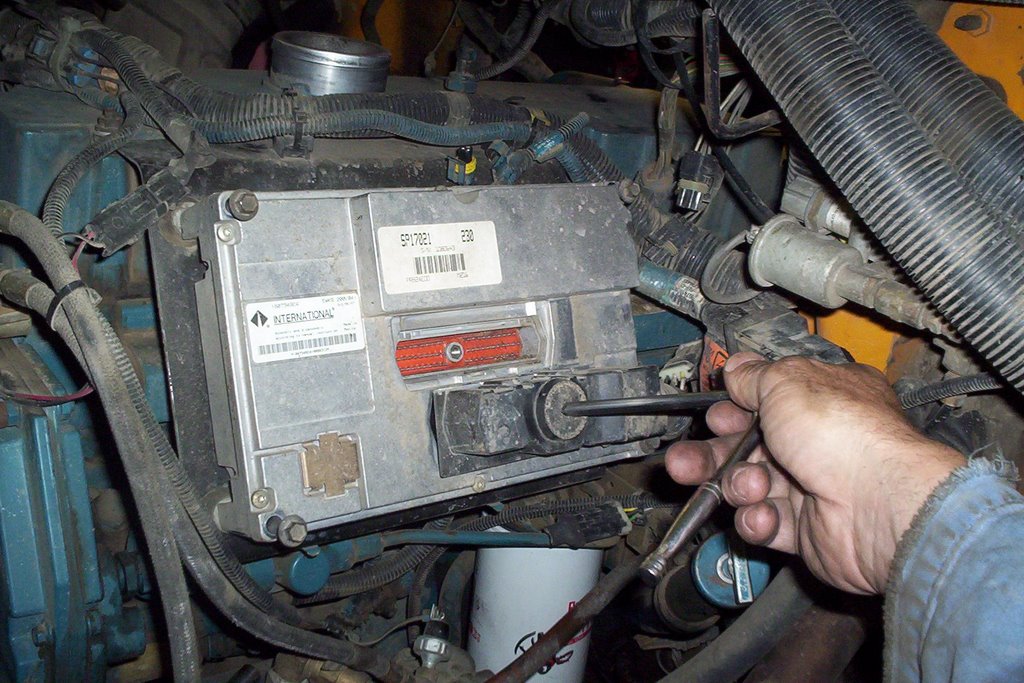
Remove the multi-pin connectors at the ECU [electronic control unit] with a 1/4 inch drive ratchet. Remove the round connector going into the valve cover housing.


Remove the 4 bolts holding ECU to the support bracket using a 10 mm socket. Remove ECU and take care it's an expensive component!
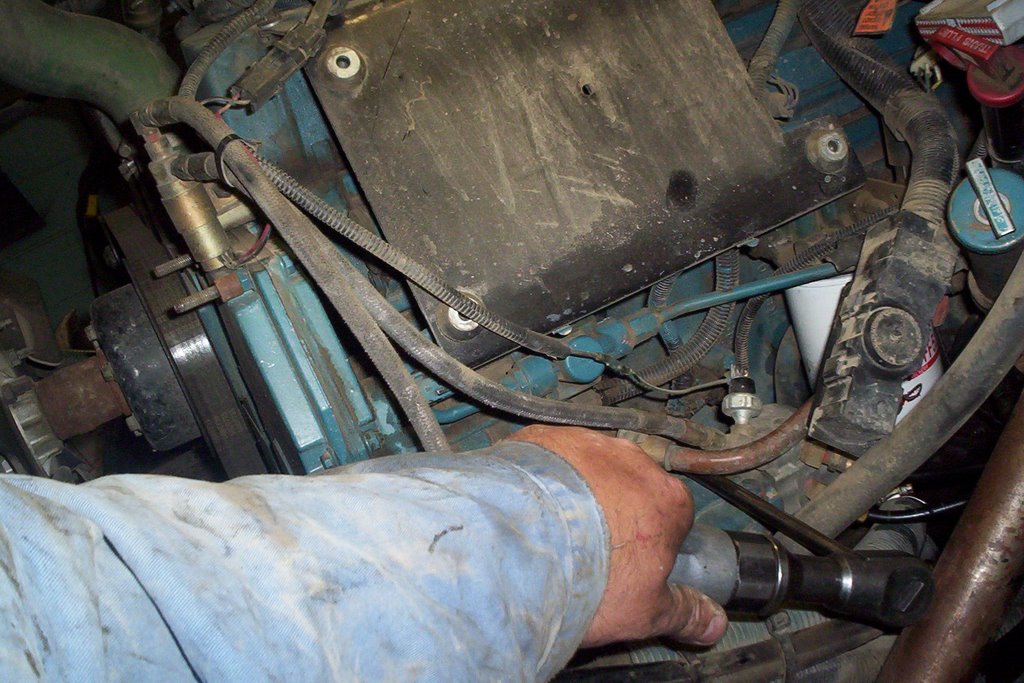

Remove ECU support bracket, there is a larger fastener below bolted to the block and 4 valve cover studs at the top side where you have to remove four retaining nuts.


Push the ECU harness connector into the valve cover housing as it will stay with the injector wiring when removing cover.
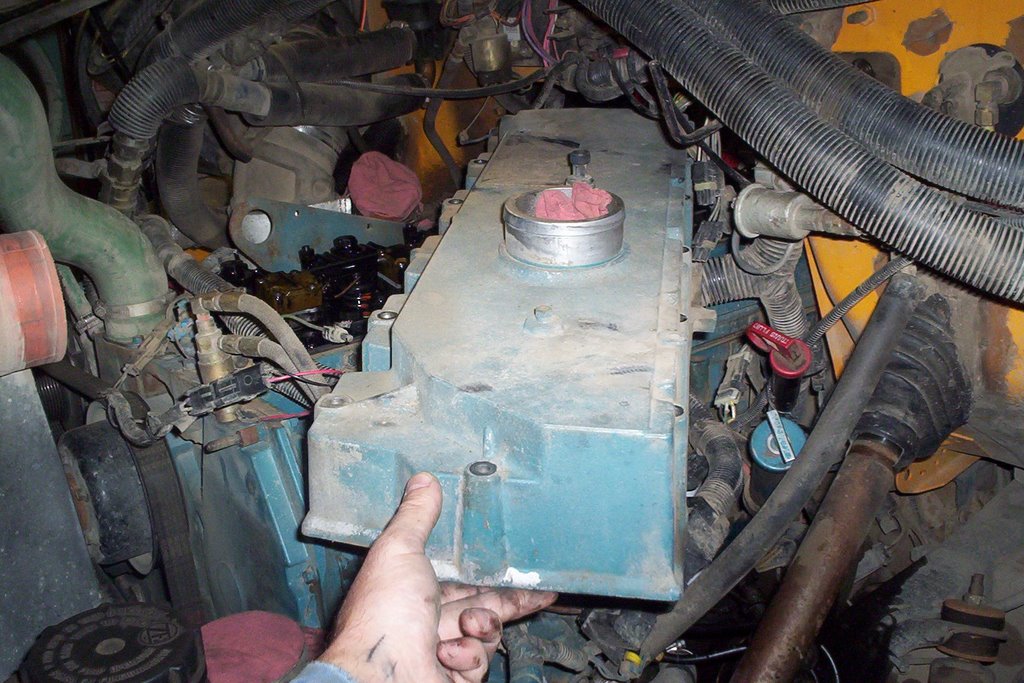

Remove valve cover, the weight has increased drastically compared to the original non-electronic engines because of the integrated intake manifold that is now part of the valve cover.

Rotate engine until TDC [top dead center] is achieved. There is a notch on the serpentine belt pulley behind the vibration dampner. An arrow and the letters TDC has been cast right into the front cover. Once lined up, the engine valves will be on #1 TDC compression or exhaust stroke.

An easy way to tell is if #1 cylinder valves are both loose and #6 cylinder valves have no clearance, then you know you are on #1 compression stroke. Note: There are 12 valves in total #1 valve being at the front while #12 valve is the last valve at the rear of of the cylinder head.

So if I say adjust #4 valve you just count from the front of the head, the first valve being #1. This makes it easier to explain which valves to adjust.

On #1 TDC compression stroke adjust adjust valves #1 #2 #3 #6 #7 #10 . The valve clearance for both intake and exhaust is .025 in. preferably with the engine cold but that's not overly crucial.

Rotate engine 360 degrees the engine is now on #6 TDC compression stroke. Adjust #4 #5 #8 #9 #11 #12 valves.

Once you have all the valves adjusted you reverse the disassembly procedure and torque the valve cover bolts to 13 ft. lbs. and the 1/4 drive wiring harness connectors at the ECU to 35 in. lbs. The valve cover gasket is reusable but still inspect it for damage or indications of wear.

I hope this helps you out when it's time to adjust valves on your DT 466E Diesel Engine.


Diesel Mechanic


Wednesday, December 22, 2010

How To Set Valves & Injectors - Cat 3116 Diesel Engine

Diesel Mechanic Tips:

Today I am going to show you how to adjust the valves and injectors on a Caterpillar 3116 Diesel Engine. The injectors are mechanical and are checked and adjusted manually using the appropriate Caterpillar tune-up tools.

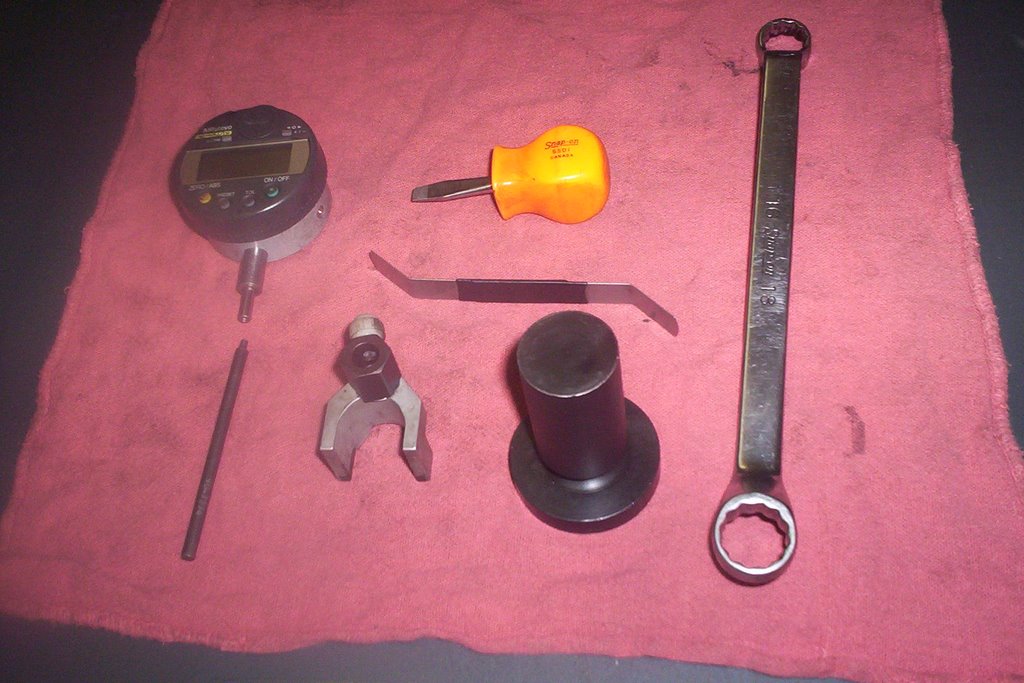
Here are the tools needed to perform the valve and injector adjustment:

Caterpillar Part #'s

*Dial Indicator # 1U-8869

*Contact Point # 9U-7274

*Feeler Guage # 123-4941

*16mm/18mm Drop Wrench # 128-8824

* Timing Guage Block # 9U-7269

Magnetic Base # 123-4940

Setting the valves and injectors is a preventive maintenance operation and should be done on a regular basis. Once you get through one setting it's a cakewalk the second time around. Below is the dataplate that tells you the timing specification for setting injectors.


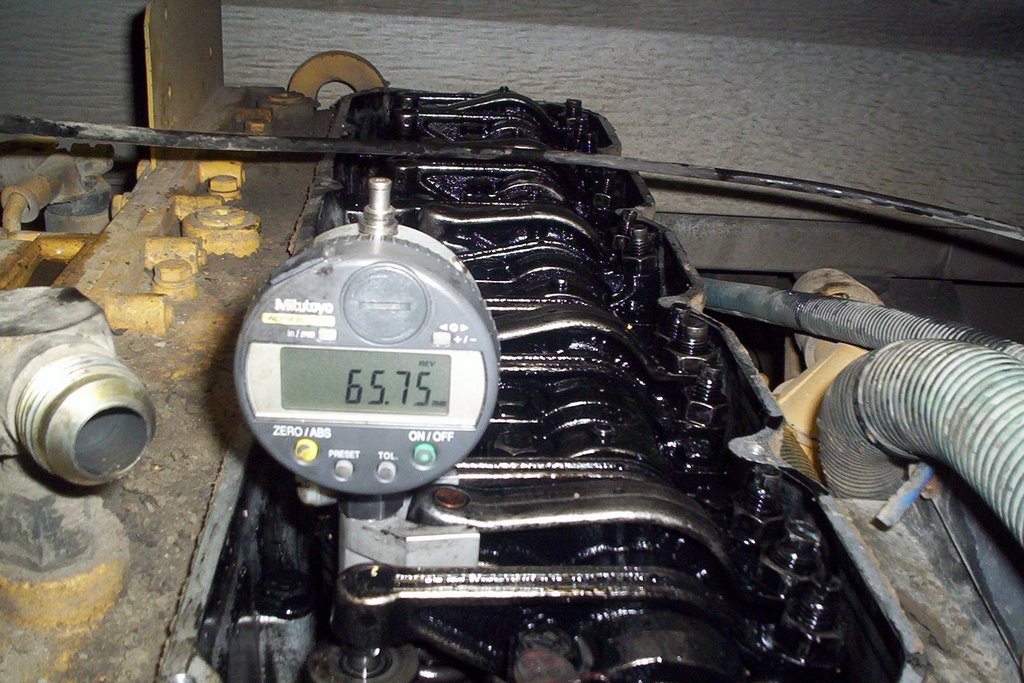
The dial indicator has to be pre-set so it reads 62.00 mm when placed on the timing guage block as shown below. These tools come with the complete Caterpillar tune-up kit with detailed instructions included.


The first thing to do is rotate the engine over until # 6 cylinder valve rockers are rocking. Watch # 6 valve rockers as you are rotating the engine, keep turning the engine until the exhaust valve closes and the intake valve JUST starts to open. Stop there, # 1 cylinder is now on the Compression Stroke and ready for valve adjustment as well as the other designated injectors and valves.

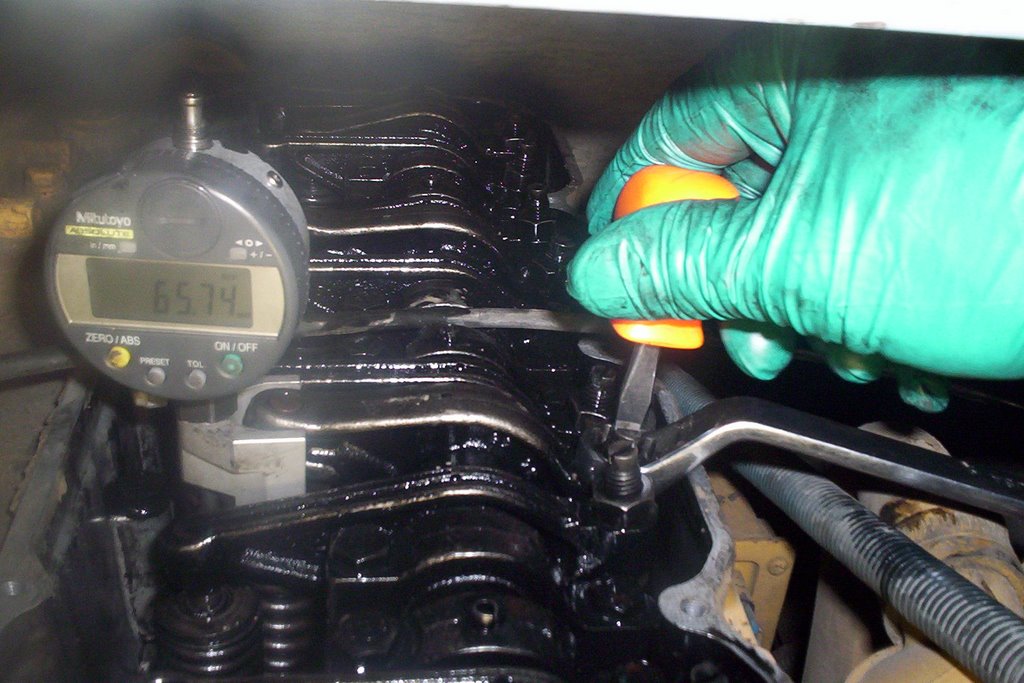
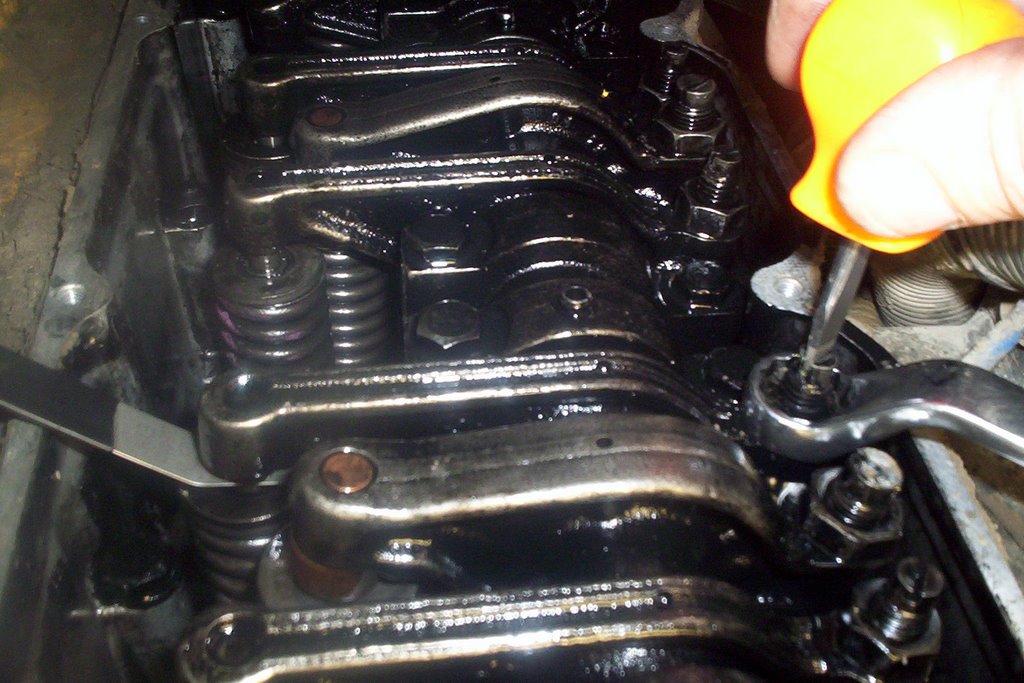
*Adjust 3-5-6 injectors to timing spec. / in this case 65.74 mm / + or - .020 mm

*Adjust 1-2-4 intake valves .015 in.

*Adjust 1-3-5 exhaust valves .025 in.

Rotate engine over 360 degrees and adjust the other remaining valves and injectors. # 6 cylinder is now on compression stroke since #1 and # 6 pistons are always at TDC [top dead center]together.

*Adjust 1-2-4 injectors

*Adjust 3-5-6 intake valves

*Adjust 2-4-6 exhaust valves

As you can see from the above picture the magnetic dial indicator holder sits on top of the injector. The dial indicator measures the distance from the top of the injector to the machined body surface at the bottom which must be set correctly. This dimension effects injection timing and can be adjusted at the injector rocker arm set screw.

I hope this post helps out all you Cat 3116 owners. The valve and injector adjustment is probably the most crucial as adjustment can change with normal wear and tear as your diesel engine racks up the mileage.

That's all for now, thanks for visiting and be sure to check back for more Diesel Mechanic Tips.


Wednesday, December 15, 2010

Bleeding Diesel Fuel System - Mercedes MBE 900 Engine

We learned the hard way & experienced troubles trying to prime the Mercedes MBE 900 Diesel Engine. It was a chore trying to get it started again after it ran out of fuel.
Pressurizing the fuel tank and bleeding the system at the fuel lines was tedious and a crude method to say the least.
Most of these engines come from the factory with a quick coupler located at the fuel filter housing. The 2005 and earlier models have to be installed with the new coupler, a kit can be obtained from the Mercedes dealer.


We acquired the female quick coupler from the local dealer and added a  hose along with a stainless steel pressure tank similar to a lawn fertilizer set up.  There isn't a lot of  pressure required to bleed the fuel system, all it takes is 5 p.s.i or better. There is a bleeding apparatus available that we are looking at picking up. I will re-post when it arrives and give it a test drive.


This tank has to be topped up with diesel and pumped continuously while a second person cranks over the engine. It works great and saves a lot of wear and tear on the starter!

Note: there is a Technical Service Bulletin on the Thomas C2 School Bus models having a defective fuel gauge senderThe sender must be removed and tested with an ohm meter. We had some incidents on one of our C2 units running out of fuel prematurely.

Once you get this pressure tool all set up it will make removing the air from a Mercedes MBE 900 Engine fuel system much easier.

Tuesday, December 14, 2010

School Bus Stopping Laws & Precautions

Jurisdictions in the United States (including overseas territories) and Canada have adopted various school bus stop laws that require drivers to stop and wait for a stopped school bus loading or unloading, so as to protect school children boarding or alighting.

Generally, a driver of a vehicle meeting or overtaking, from either direction (front or back), a stopped school bus flashing alternating red lamps must stop and wait until the bus moves again or the red lights are off.[1] Police officers, school crossing guards, and even school bus drivers themselves may have the power to wave traffic on, even when red lights are flashing.

On divided highways, most American and Canadian jurisdictions do not require vehicular drivers to stop when on the opposite side of the road from a stopped school bus. Those that do require vehicles to stop are:

* West Virginia upon a non-controlled-access highway
* Arkansas in case a divider has less than 20 feet
(6 m) in width (narrow divider)
* Mississippi
* New York State
* American Samoa
* Guam
* British Columbia
* Nova Scotia
* Prince Edward Island
* Northwest Territories
* Nunavut

American and Canadian jurisdictions have sought to deter illegal passing stopped school buses by increased enforcement and heavy penalties, including fines, application of demerit points against a driver's license or even license suspension. Nevertheless, violations are common.

An officer must witness the violation, and even when citations issued, getting convictions is often difficult; sometimes traffic courts consider the evidence insufficient, or reduce the charge because the penalty for a first offense seems excessive.

Thanks to Wikipedia.org


Friday, December 10, 2010

DT466 Engines Die Hard

The DT466 Engine has come a long way from the Mechanical injection systems to today's electronic versions. They started like clockwork in cold weather and reminded me of the Duracell Bunny you see in commercials. The video below is a typical cold start scenario and these engines don't take long to get going even in 20 degree weather.

A good set of 800 CCA batteries will get you going in any kind of weather. The DT466 electronic engines are much harder to start in the cold because of the high pressure oil required to run the injectors which are hydraulically actuated. So thick oil has enough resistance to hold back one of these models from firing up.

Plugging them in is essential (as with any diesel engine) and even throwing in an oil pan heater is a great help. I found a magnetic oil pan heater that gets up to 200 degrees and makes quite a difference with cold starts.

I found from experience that when the engine starts to fire but still struggles to give it a short rest before cranking it over again. The Delco starter (most likely a 37 MT Model)is earning it's keep in this type of weather, you can only imagine the amount of load it's going through. What a machine!


Please leave a Comment!

Thursday, December 02, 2010

Mercedes MBE 900 Diesel Engine - Changing Thermostats

MBE 900 Diesel Engine Specs:

Configuration: inline 6

Displacement: 7.2 Liters
(439 cu in)

Bore: 4.17 in (106 mm)

Stroke: 5.35 in (136 mm)

Weight: 1,362 lbs (618 kg)

Electronics: DDEC® VI

Compression Ratio: 18:1


The local Mercedes dealer recommended to replace thermostats and coolant every two years on the MBE 900. Coolant breaks down over time and becomes acidic chowing down on gaskets and engine parts. On a conventional and pusher bus this is an easy operation. Three bolts and upper rad hose is all it takes to get to the thermostats.


The two thermostats come with a split o-ring that fits around the edge of the stat and nestles nicely into the bore of the thermostat housing. Below is a short video of a Mercedes MBE 900 diesel engine idling in a pusher bus. These engines come with  EGR and DPF (Diesel Particulate Filter) systems to control emissions. Check out how the emissions are controlled using these components Right Here.