Showing posts with label diesel engines. Show all posts
Showing posts with label diesel engines. Show all posts
Monday, December 25, 2017
Mercedes MBE Diesel Engine Pusher School Bus
The cold start on this bus was perfect without any hold ups. It was plugged in and the batteries are obviously in good shape. Of course with most diesel engines the white smoke is normal with incomplete combustion going on. Heat from compression is low in this case so it takes a while for normal combustion temperatures to occur. The rule of thumb with diesel engines in my book is to put the engine to work as soon as you get normal oil pressure or at least make sure the high idle mode is on. Idling a diesel in cold weather is not a good practice because of the build up of carbon and related combustion byproducts that happen with cold starts.
These MBE 900 diesels are good solid engines except for the emissions which was adapted to the original block in 2007. The blocks can not be swapped from non emissions to these 2007 models because of added modules that were engineered to meet emission standards. I know this from experience we have a 2008 MBE that has a cracked block and no one can find me a bare block for it. There are plenty of non emission blocks around but nothing newer. The long block is available from the dealer but at a huge cost and a core charge that we would not get back due to the crack in the block.
When the warranty was up with these engines we were in for a lot of challenges. The engine codes were running away on us with daily occurrences with the EGR valves, DPF diesel particulate filter, EOS electrostatic oil separator along with boost and charge air codes that did not let up. Two of these pushers were sports run buses and almost every trip they would radio back and tell me the engine was coding. One saving grace was the ignition key could be cycled on and off which would reset the code until it came back again. But this would stress me out regardless being helpless with the bus so far away. One bus was 4 hours out of town and I spent hours trying to line up a service call to do a parked regen or else the bus was dead in the water.
Eventually these 2 bad boys were taken off of the sports run and we started using newer Cummins ISC diesel engines. The pressure was off and if you have read any of my other posts Cummins is my choice for a diesel engine medium duty ISB and ISC models. Yes they don't last forever there are quirks and failures but an extremely smaller percentage compared to other diesels on the road. Preventive maintenance had proven to extend down time and the extra cost is money well spent.


Thursday, June 27, 2013
School Bus Garage Photos
I've been taking photos in our school bus garage since 2005 and didn't want them to go to waste so here is a short video with RANDOM pics. There's everything from instant snow chains to engine repair.
2005...I remember it well, we still had mechanical diesel engines in the fleet. They were semi-retired as spare buses and just this year we are auctioning off our last mechanical engine equipped units (Cat 3116 models). The 3116 Cat gave us pretty good service but nothing stellar to speak of.
I believe there were 4 engine rebuilds because of the exhaust valve dropping at a very bad moment. Usually the high heat pulling full load would cause the mishap. It was a lot of work since the block was solid without removable piston liners. The entire engine had to be removed from the chassis, stripped down and rebuilt from scratch. The rebuilt head ran about 1500 dollars Canadian, if the cylinder wall was scored then the block was sent to a machine shop which MUST know the repair steps when boring and re-sleeving these engines.
There is a special jig to be used to secure the block so it doesn't warp during the re-bore. It adds up to about 5K labor and parts. This of course is far less than buying a long block. The top end on the 3116 was the weakest part of the engine so valve adjustment is crucial. The engine operating temperature is a factor as well so they need TLC or they start to heat up over 200 degrees.
The engine fan in the pusher school buses were transversely mounted so it was hard to keep the temperature down especially in warmer months. We disabled the shutters (opened permanently) and installed an over riding dash switch to turn the engine fan on full which took some horsepower out of the engine. In the video you'll see the coolant sensor that runs the hydraulic fan solenoid.
When you unhook the sensor wire the fan runs full on. The dash switch we installed for the driver just caused a break in the circuit. It should also be mentioned that the cooling system also had to cool the transmission oil which could get up to 200 degrees. The radiator mounted sideways at the back of the bus had a hard time cooling especially when the bus was in 3rd gear with a full load climbing a hill in 80 degree weather. Thanks for viewing this post and I hope you liked the video.
2005...I remember it well, we still had mechanical diesel engines in the fleet. They were semi-retired as spare buses and just this year we are auctioning off our last mechanical engine equipped units (Cat 3116 models). The 3116 Cat gave us pretty good service but nothing stellar to speak of.
I believe there were 4 engine rebuilds because of the exhaust valve dropping at a very bad moment. Usually the high heat pulling full load would cause the mishap. It was a lot of work since the block was solid without removable piston liners. The entire engine had to be removed from the chassis, stripped down and rebuilt from scratch. The rebuilt head ran about 1500 dollars Canadian, if the cylinder wall was scored then the block was sent to a machine shop which MUST know the repair steps when boring and re-sleeving these engines.
There is a special jig to be used to secure the block so it doesn't warp during the re-bore. It adds up to about 5K labor and parts. This of course is far less than buying a long block. The top end on the 3116 was the weakest part of the engine so valve adjustment is crucial. The engine operating temperature is a factor as well so they need TLC or they start to heat up over 200 degrees.
The engine fan in the pusher school buses were transversely mounted so it was hard to keep the temperature down especially in warmer months. We disabled the shutters (opened permanently) and installed an over riding dash switch to turn the engine fan on full which took some horsepower out of the engine. In the video you'll see the coolant sensor that runs the hydraulic fan solenoid.
When you unhook the sensor wire the fan runs full on. The dash switch we installed for the driver just caused a break in the circuit. It should also be mentioned that the cooling system also had to cool the transmission oil which could get up to 200 degrees. The radiator mounted sideways at the back of the bus had a hard time cooling especially when the bus was in 3rd gear with a full load climbing a hill in 80 degree weather. Thanks for viewing this post and I hope you liked the video.
Wednesday, April 06, 2011
School Bus Engine Rebuild Video Cat 3116
Here's a video I put together going through the steps to rebuilding and installing a Cat 3116 Diesel engine in a pusher school bus. It's a big job and you can see it happen in a matter of minutes. It's much easier to assemble the transmission to the engine and use the trans jack for support and hydraulic hoist on the front end.
The whole works rolls right into the frame. Thankfully Thomas Bus allows the rear end frame to be removed. The Cat 3116 is a fussy engine to set up and you MUST have the Cat tool kit. There is no way to set up the timing, synchronization & fuel setting without the kit.
The valve train is the only weak spot on these engines, when they get too hot (in this case) the exhaust valve let loose requiring the major repair including a new cylinder head. Too avoid this keep the engine temperature down and check valve adjustment every 30,000 to 40,000 km (18-24,000 Miles). Enjoy the video....Please Leave a Comment
School Bus Mechanic Pictures..Exclusive! by jelletse
The whole works rolls right into the frame. Thankfully Thomas Bus allows the rear end frame to be removed. The Cat 3116 is a fussy engine to set up and you MUST have the Cat tool kit. There is no way to set up the timing, synchronization & fuel setting without the kit.
The valve train is the only weak spot on these engines, when they get too hot (in this case) the exhaust valve let loose requiring the major repair including a new cylinder head. Too avoid this keep the engine temperature down and check valve adjustment every 30,000 to 40,000 km (18-24,000 Miles). Enjoy the video....Please Leave a Comment
School Bus Mechanic Pictures..Exclusive! by jelletse
Tuesday, April 05, 2011
Diesel Engine Overheating School Bus Pusher
The diesel engine on a school bus pusher is a strange design with a transversely mounted radiator. Operators love these units because are very quiet (engine in the rear) with a stubby driveshaft. Low occurrences of driveline vibration and hearing yourself think is a bonus.
One thing that does cause problems is the hydraulic fan drive system that runs the engine cooling fan. The steering pump driven off the compressor runs the fan hydraulic motor as well. For those who find this confusing, the engine fan assy. is attached to the hydraulic motor shaft. Since the motor is driven by the steering pump it is labelled as a motor.
If you find you have stiff steering and the engine is overheating as well, you might want to look at the hydraulic steering pump. Check the hydraulic filter and magnet that resides inside the oil reservoir. If there is anything metallic then you're on the right track.
Older fan drives have a control manifold that has a electric solenoid that is triggered by an engine coolant temperature sensor. once the 200 degree (approx.) engine temperature is reached then the flow control opens the gates to full flow directed to the hydraulic fan drive motor. There is no need to worry about a fan belt on these rigs.
Newer pusher school buses have a 2 stage steering pump with sensors and manifold that controls the engine fan with a module bolted to the side of the frame. One stage of the hydraulic pump runs the steering and the other stage runs the engine fan. You also need the software to hookup to the fan control module to check out the entire system for proper flow and other parameters.
School buses have come a long way from the old belt drive and incredibly noisy gear box system that were popular in the early 90s. I think I've just dated myself, OK now you know I'm a child of the 60s... Hooray for Bob Dylan and the Chevy 283 cu. in. engine.
One thing that does cause problems is the hydraulic fan drive system that runs the engine cooling fan. The steering pump driven off the compressor runs the fan hydraulic motor as well. For those who find this confusing, the engine fan assy. is attached to the hydraulic motor shaft. Since the motor is driven by the steering pump it is labelled as a motor.
If you find you have stiff steering and the engine is overheating as well, you might want to look at the hydraulic steering pump. Check the hydraulic filter and magnet that resides inside the oil reservoir. If there is anything metallic then you're on the right track.
Older fan drives have a control manifold that has a electric solenoid that is triggered by an engine coolant temperature sensor. once the 200 degree (approx.) engine temperature is reached then the flow control opens the gates to full flow directed to the hydraulic fan drive motor. There is no need to worry about a fan belt on these rigs.
Newer pusher school buses have a 2 stage steering pump with sensors and manifold that controls the engine fan with a module bolted to the side of the frame. One stage of the hydraulic pump runs the steering and the other stage runs the engine fan. You also need the software to hookup to the fan control module to check out the entire system for proper flow and other parameters.
School buses have come a long way from the old belt drive and incredibly noisy gear box system that were popular in the early 90s. I think I've just dated myself, OK now you know I'm a child of the 60s... Hooray for Bob Dylan and the Chevy 283 cu. in. engine.
Friday, December 31, 2010
Valve Adjustment On A DT466E International Diesel Engine
DIESEL MECHANIC - How To Adjust Valves On An International DT 466E Diesel Engine
Diesel Mechanic

The DT 466E diesel engine is the electronic version of the former DT 466. This an engine we diesel mechanics all know and love since they are virtually almost bulletproof with a fantastic performance record. With emissions standards here to stay International has followed the other engine manufacturers and engineered electronic injection into their design.
The hardest part about working on these diesel engines is getting to the components, especially the valves if it's time for adjustment. The air to air piping has to be removed as well as the doghouse cover from inside the cab followed by the electronic control unit. These steps are required just to be able to reach the valve cover bolts.
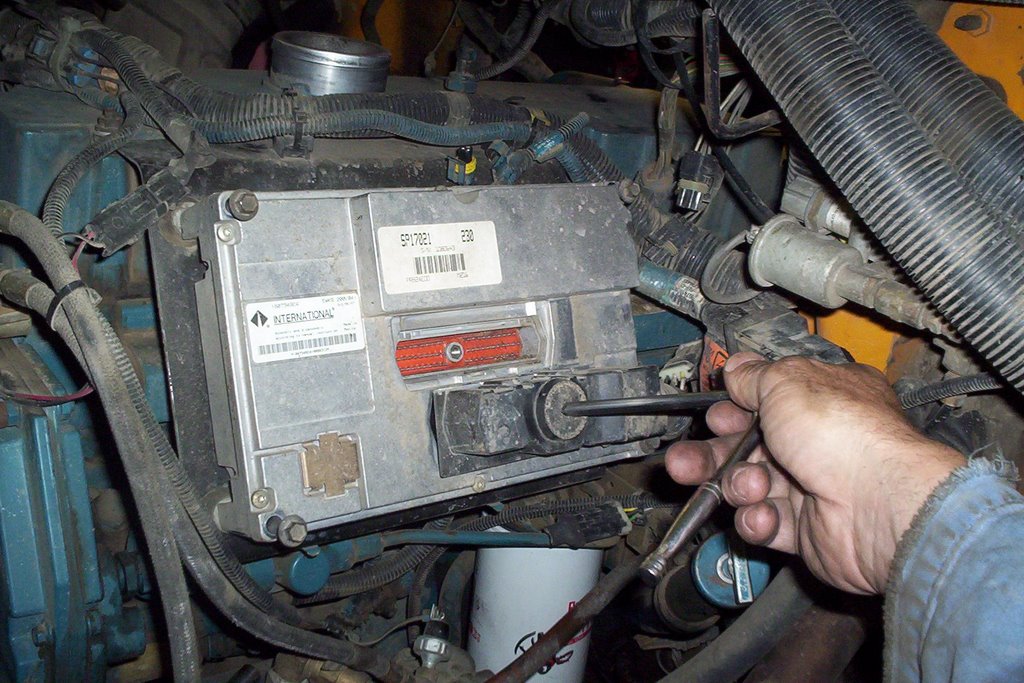 Remove the multi-pin connectors at the ECU [electronic control unit] with a 1/4 inch drive ratchet. Remove the round connector going into the valve cover housing.
 Remove the 4 bolts holding ECU to the support bracket using a 10 mm socket. Remove ECU and take care it's an expensive component!
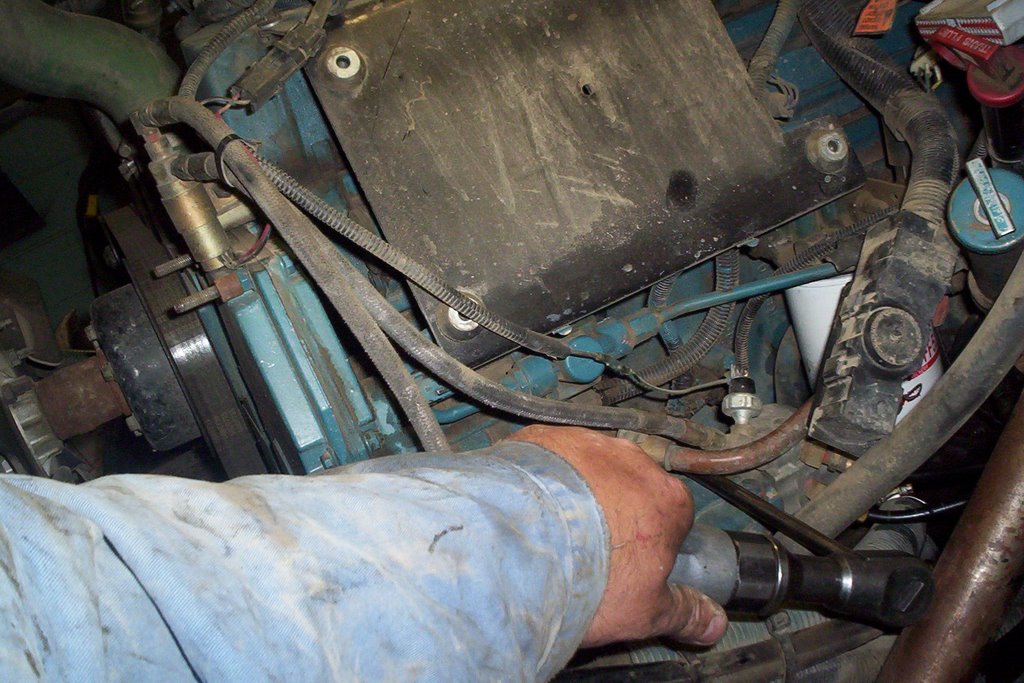 Remove ECU support bracket, there is a larger fastener below bolted to the block and 4 valve cover studs at the top side where you have to remove four retaining nuts.
 Push the ECU harness connector into the valve cover housing as it will stay with the injector wiring when removing cover.
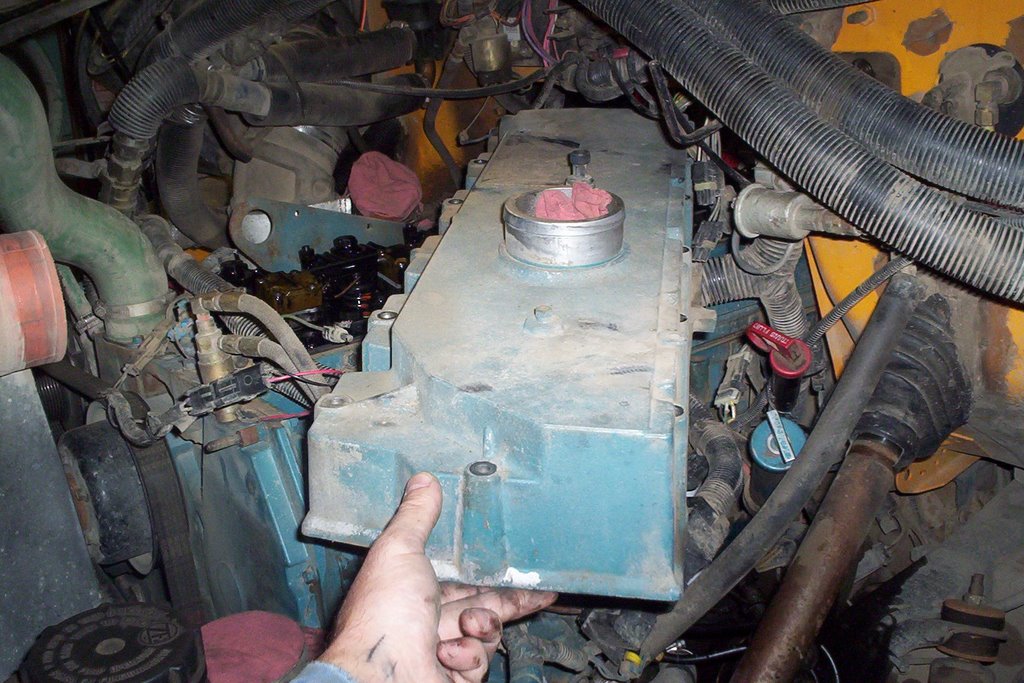 Remove valve cover, the weight has increased drastically compared to the original non-electronic engines because of the integrated intake manifold that is now part of the valve cover.
 Rotate engine until TDC [top dead center] is achieved. There is a notch on the serpentine belt pulley behind the vibration dampner. An arrow and the letters TDC has been cast right into the front cover. Once lined up, the engine valves will be on #1 TDC compression or exhaust stroke.
An easy way to tell is if #1 cylinder valves are both loose and #6 cylinder valves have no clearance, then you know you are on #1 compression stroke. Note: There are 12 valves in total #1 valve being at the front while #12 valve is the last valve at the rear of of the cylinder head.
So if I say adjust #4 valve you just count from the front of the head, the first valve being #1. This makes it easier to explain which valves to adjust.
On #1 TDC compression stroke adjust adjust valves #1 #2 #3 #6 #7 #10 . The valve clearance for both intake and exhaust is .025 in. preferably with the engine cold but that's not overly crucial.
Rotate engine 360 degrees the engine is now on #6 TDC compression stroke. Adjust #4 #5 #8 #9 #11 #12 valves.
 Once you have all the valves adjusted you reverse the disassembly procedure and torque the valve cover bolts to 13 ft. lbs. and the 1/4 drive wiring harness connectors at the ECU to 35 in. lbs. The valve cover gasket is reusable but still inspect it for damage or indications of wear.
I hope this helps you out when it's time to adjust valves on your DT 466E Diesel Engine.
Diesel Mechanic
Wednesday, December 22, 2010
How To Set Valves & Injectors - Cat 3116 Diesel Engine
Diesel Mechanic Tips:
Today I am going to show you how to adjust the valves and injectors on a Caterpillar 3116 Diesel Engine. The injectors are mechanical and are checked and adjusted manually using the appropriate Caterpillar tune-up tools.
Here are the tools needed to perform the valve and injector adjustment:
Caterpillar Part #'s
*Dial Indicator # 1U-8869
*Contact Point # 9U-7274
*Feeler Guage # 123-4941
*16mm/18mm Drop Wrench # 128-8824
* Timing Guage Block # 9U-7269
Magnetic Base # 123-4940
 The dial indicator has to be pre-set so it reads 62.00 mm when placed on the timing guage block as shown below. These tools come with the complete Caterpillar tune-up kit with detailed instructions included.

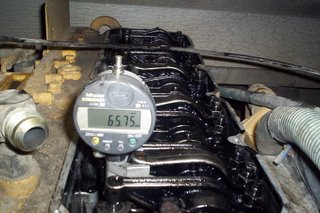 The first thing to do is rotate the engine over until # 6 cylinder valve rockers are rocking. Watch # 6 valve rockers as you are rotating the engine, keep turning the engine until the exhaust valve closes and the intake valve JUST starts to open. Stop there, # 1 cylinder is now on the Compression Stroke and ready for valve adjustment as well as the other designated injectors and valves.
Today I am going to show you how to adjust the valves and injectors on a Caterpillar 3116 Diesel Engine. The injectors are mechanical and are checked and adjusted manually using the appropriate Caterpillar tune-up tools.
Here are the tools needed to perform the valve and injector adjustment:
Caterpillar Part #'s
*Dial Indicator # 1U-8869
*Contact Point # 9U-7274
*Feeler Guage # 123-4941
*16mm/18mm Drop Wrench # 128-8824
* Timing Guage Block # 9U-7269
Magnetic Base # 123-4940
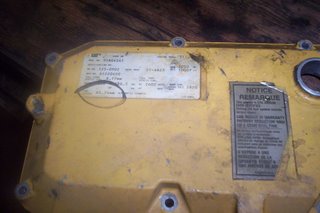
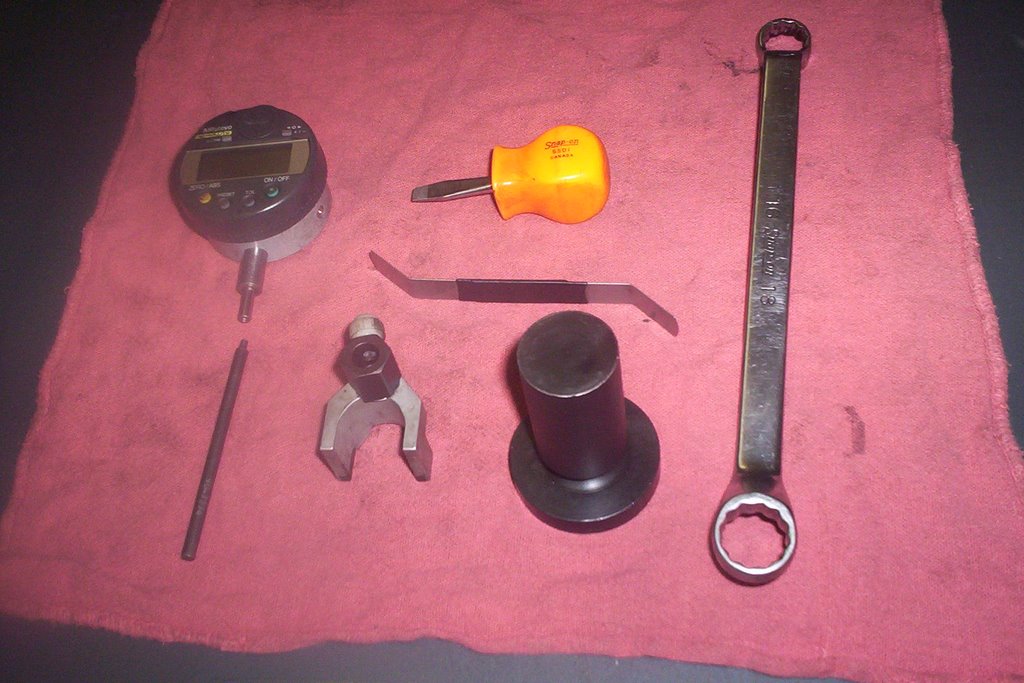 Setting the valves and injectors is a preventive maintenance operation and should be done on a regular basis. Once you get through one setting it's a cakewalk the second time around. Below is the dataplate that tells you the timing specification for setting injectors.
 The dial indicator has to be pre-set so it reads 62.00 mm when placed on the timing guage block as shown below. These tools come with the complete Caterpillar tune-up kit with detailed instructions included.
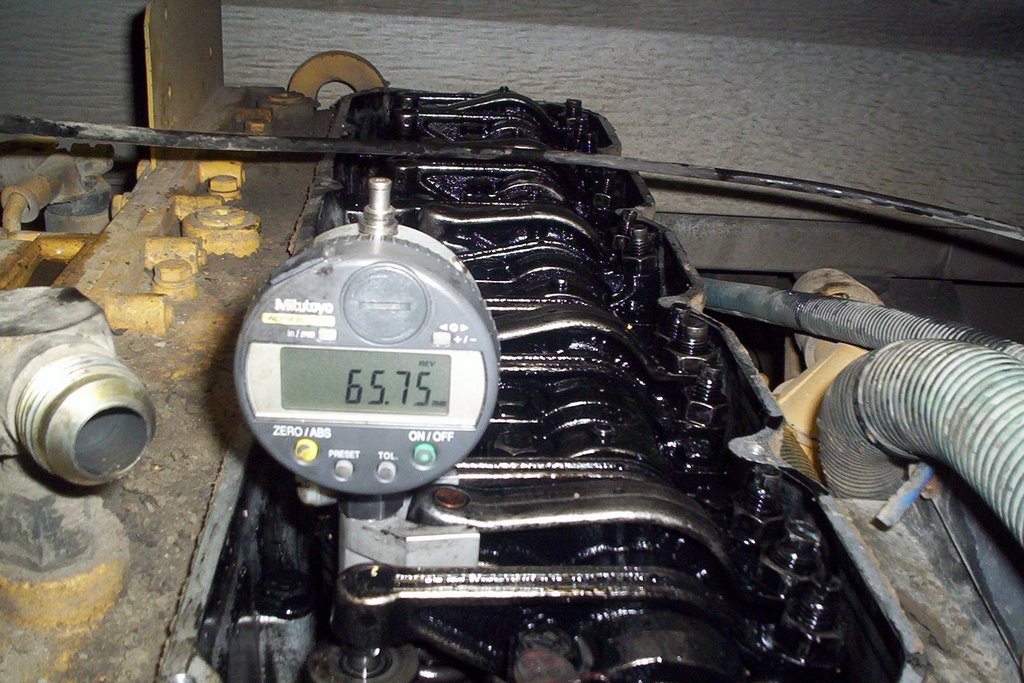 The first thing to do is rotate the engine over until # 6 cylinder valve rockers are rocking. Watch # 6 valve rockers as you are rotating the engine, keep turning the engine until the exhaust valve closes and the intake valve JUST starts to open. Stop there, # 1 cylinder is now on the Compression Stroke and ready for valve adjustment as well as the other designated injectors and valves.
 *Adjust 3-5-6 injectors to timing spec. / in this case 65.74 mm / + or - .020 mm
*Adjust 1-2-4 intake valves .015 in.
*Adjust 1-3-5 exhaust valves .025 in.
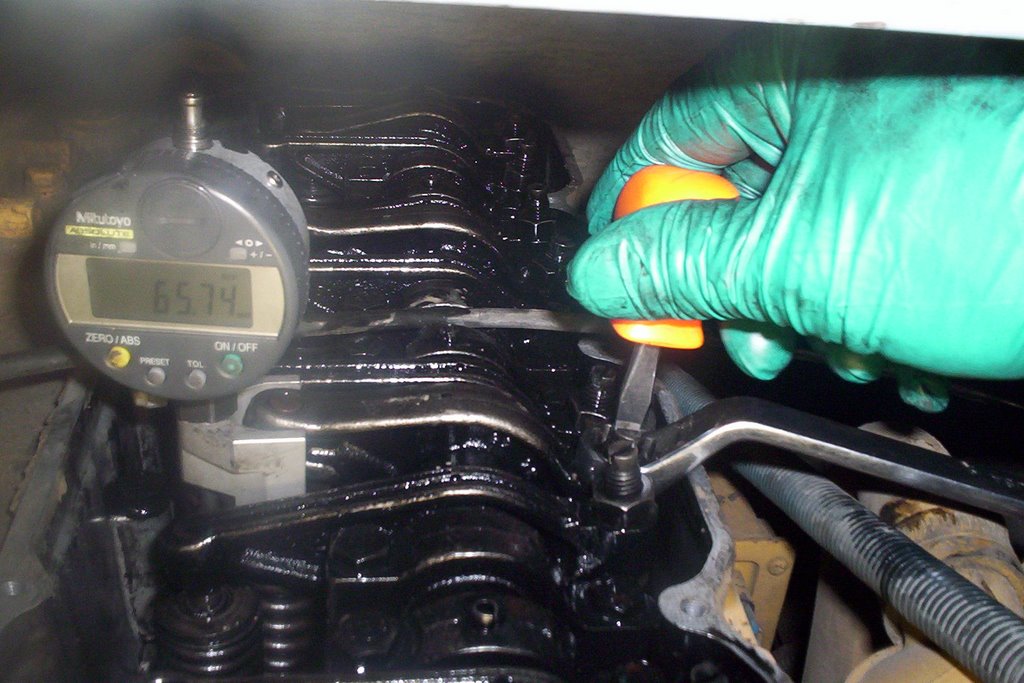 Rotate engine over 360 degrees and adjust the other remaining valves and injectors. # 6 cylinder is now on compression stroke since #1 and # 6 pistons are always at TDC [top dead center]together.
*Adjust 1-2-4 injectors
*Adjust 3-5-6 intake valves
*Adjust 2-4-6 exhaust valves
As you can see from the above picture the magnetic dial indicator holder sits on top of the injector. The dial indicator measures the distance from the top of the injector to the machined body surface at the bottom which must be set correctly. This dimension effects injection timing and can be adjusted at the injector rocker arm set screw.
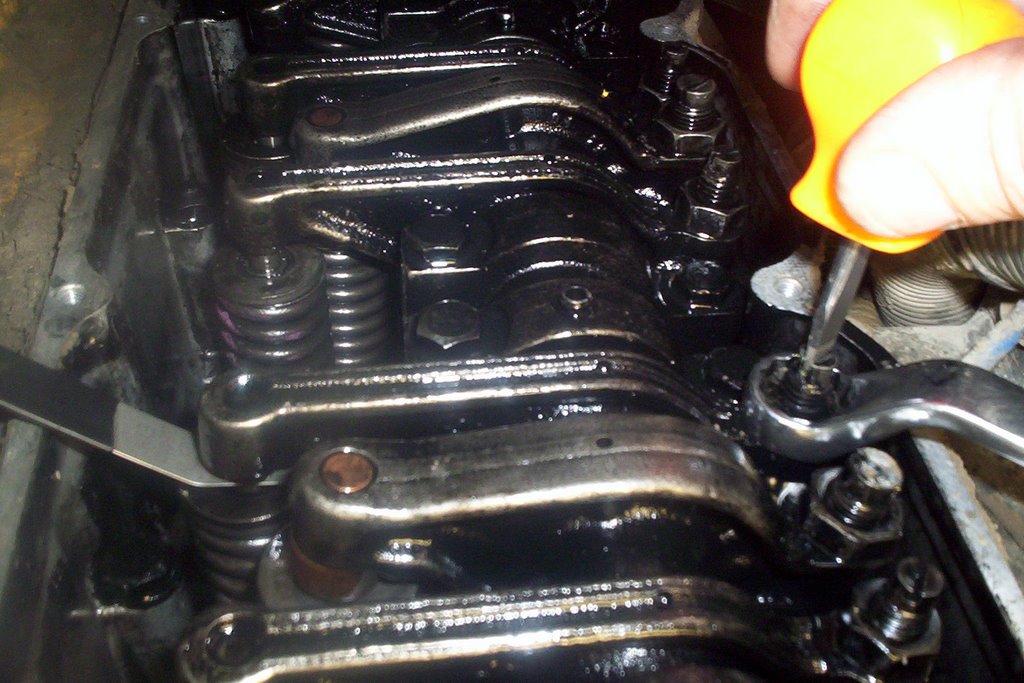
I hope this post helps out all you Cat 3116 owners. The valve and injector adjustment is probably the most crucial as adjustment can change with normal wear and tear as your diesel engine racks up the mileage.
That's all for now, thanks for visiting and be sure to check back for more Diesel Mechanic Tips.
Thursday, December 02, 2010
Mercedes MBE 900 Diesel Engine - Changing Thermostats
MBE 900 Diesel Engine Specs:
Configuration: inline 6
Displacement: 7.2 Liters
(439 cu in)
Bore: 4.17 in (106 mm)
Stroke: 5.35 in (136 mm)
Weight: 1,362 lbs (618 kg)
Electronics: DDEC® VI
Compression Ratio: 18:1

The local Mercedes dealer recommended to replace thermostats and coolant every two years on the MBE 900. Coolant breaks down over time and becomes acidic chowing down on gaskets and engine parts. On a conventional and pusher bus this is an easy operation. Three bolts and upper rad hose is all it takes to get to the thermostats.

The two thermostats come with a split o-ring that fits around the edge of the stat and nestles nicely into the bore of the thermostat housing. Below is a short video of a Mercedes MBE 900 diesel engine idling in a pusher bus. These engines come with EGR and DPF (Diesel Particulate Filter) systems to control emissions. Check out how the emissions are controlled using these components Right Here.
Configuration: inline 6
Displacement: 7.2 Liters
(439 cu in)
Bore: 4.17 in (106 mm)
Stroke: 5.35 in (136 mm)
Weight: 1,362 lbs (618 kg)
Electronics: DDEC® VI
Compression Ratio: 18:1

The local Mercedes dealer recommended to replace thermostats and coolant every two years on the MBE 900. Coolant breaks down over time and becomes acidic chowing down on gaskets and engine parts. On a conventional and pusher bus this is an easy operation. Three bolts and upper rad hose is all it takes to get to the thermostats.

The two thermostats come with a split o-ring that fits around the edge of the stat and nestles nicely into the bore of the thermostat housing. Below is a short video of a Mercedes MBE 900 diesel engine idling in a pusher bus. These engines come with EGR and DPF (Diesel Particulate Filter) systems to control emissions. Check out how the emissions are controlled using these components Right Here.
Wednesday, November 24, 2010
Diesel Mechanic Books & The Importance Of Knowledge
Diesel Mechanic Books are the lifeblood for any Mechanic looking to increase his or her knowledge and efficiency. I have always depended on up to date information to reduce the guessing game when troubleshooting and repairing diesel engines. You will learn something new everyday and hopefully that new found knowledge will be in a positive light.
Knowing exactly how to disassemble and reassemble a diesel engine or adjust a fuel injection pump gives you the instant confidence you need to succeed. There is a difference between studying a book compared to a CD. Everyone has their preference. If you don't have access to a computer the book option is right for you.
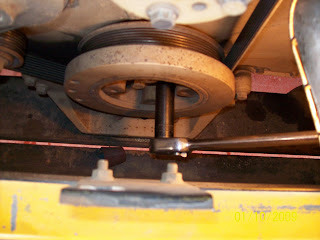
BARRING OVER A CUMMINS ISC DIESEL ENGINE FOR A VALVE SETTING
Knowing torque specs & parameters along with a diagnostic procedure will save time and headaches. There are thousands of diesel engine books covering specific diesel engines and fuel injection systems that is an essential tool for the conscientious Mechanic who prides himself on the doing the job right. If you go into a job blind you're looking for trouble, the complexities of a modern diesel engine far exceeds the engines from 20 years ago. Emission Controls are computer driven and have to be respected using the right tools and know-how.
My First Diesel Engine Rebuild Story
When I was a greenhorn apprentice in my 2nd year I was instructed to rebuild a Cummins NTA 350 Diesel Engine (N = series T = Turbocharged A = Aftercooled). YIKES! Here I was 19 years old tearing down a truck driver's engine with his livelihood depending on me. This was my first rebuild so that Cummins overhaul manual went home with me every night. I studied that until I had it memorized. It would have been a losing proposition if I never had that diesel mechanic book by my side.
These engines were straight mechanical, the fuel injection timing was checked with 2 dial indicators. One on the injector cam lobe and the other on the piston. The timing was altered with shim / gaskets for the cam followers according to the dial indicator readings. The counterbore also had to be cut with a manual cutter where each cylinder wet sleeve fit into making sure there was the proper protrusion above the block surface to allow proper sealing for the head gasket.
I can't imagine what it would have been like to do this job without an engine manual. What an adventure that would have been!
ADJUSTING VALVES ON AN INTERNATIONAL DT466E DIESEL ENGINE

REPLACING A REAR SEAL ON A DT466E DIESEL ENGINE

Each diesel engine running on the road today is unique with their stand-alone design and fuel injection system. Diesel engine books will save your butt if you use them and follow the guidelines. Thousands of hours of research go into these books...it would only take a fraction of that time to look up a spec or procedure that could inevitably save your reputation.
are the lifeblood for any Mechanic looking to increase his or her knowledge and efficiency. I have always depended on up to date information to reduce the guessing game when troubleshooting and repairing diesel engines. You will learn something new everyday and hopefully that new found knowledge will be in a positive light. Knowing exactly how to disassemble and reassemble a diesel engine or adjust a fuel injection pump gives you the instant confidence you need to succeed. There is a difference between studying a book compared to a CD. Everyone has their preference. If you don't have access to a computer the book option is right for you.
BARRING OVER A CUMMINS ISC DIESEL ENGINE FOR A VALVE SETTING

Knowing torque specs & parameters along with a diagnostic procedure will save time and headaches. There are thousands of diesel engine books covering specific diesel engines and fuel injection systems that is an essential tool for the conscientious Mechanic who prides himself on the doing the job right. If you go into a job blind you're looking for trouble, the complexities of a modern diesel engine far exceeds the engines from 20 years ago. Emission Controls are computer driven and have to be respected using the right tools and know-how.
My First Diesel Engine Rebuild Story
When I was a greenhorn apprentice in my 2nd year I was instructed to rebuild a Cummins NTA 350 Diesel Engine (N = series T = Turbocharged A = Aftercooled). YIKES! Here I was 19 years old tearing down a truck driver's engine with his livelihood depending on me. This was my first rebuild so that Cummins overhaul manual went home with me every night. I studied that until I had it memorized. It would have been a losing proposition if I never had that diesel mechanic book by my side.
These engines were straight mechanical, the fuel injection timing was checked with 2 dial indicators. One on the injector cam lobe and the other on the piston. The timing was altered with shim / gaskets for the cam followers according to the dial indicator readings. The counterbore also had to be cut with a manual cutter where each cylinder wet sleeve fit into making sure there was the proper protrusion above the block surface to allow proper sealing for the head gasket.
I can't imagine what it would have been like to do this job without an engine manual. What an adventure that would have been!
ADJUSTING VALVES ON AN INTERNATIONAL DT466E DIESEL ENGINE
REPLACING A REAR SEAL ON A DT466E DIESEL ENGINE

In conclusion... having a reference to follow is essential when tackling a big job that you haven't performed yet or just need some torque specs. Most repairs on diesel engines are time consuming and could end up costing a bundle if one step is missed or a component isn't torqued down properly. It sounds easy pulling a head off an engine but each manufacturer has designed their diesel model differently with various procedures unlike any other engine on the market.
Each diesel engine running on the road today is unique with their stand-alone design and fuel injection system. Diesel engine books will save your butt if you use them and follow the guidelines. Thousands of hours of research go into these books...it would only take a fraction of that time to look up a spec or procedure that could inevitably save your reputation. Please leave your comments, feedback & questions below.
Thursday, October 21, 2010
Diesel Engine Troubleshooting GM 6.5
When it comes to diesel engine troubleshooting you're opening up a really big can of worms. There are so many models and designs that you would need several years of study to know everything about them. However I have seen so many of the same failures in non-fuel injected areas of a diesel engine that it's always a good practice to check the simple things first.
If you start at the fuel tank (The Source) think about the problem and if lack of fuel is related to the symptoms. Is the engine hunting and sounding like Grandma's old wringer washer? If the flow of fuel is interrupted by a restriction or a gaping hole in the suction line then you will get this type of symptom.
If you're getting plumes of black smoke then there's too much fuel that could be caused by a bad injector. With today's electronic engines if you don't have a laptop, all I can say is Good Luck. If you have a bad sensor somewhere you gotta have a computer hooked up to find it.
I know it's tougher and more expensive to run a diesel these days but it's all for the good of helping sustain a healthy environment, I'm all for that but the frustration is accelerated sometimes when a problem isn't poking you in the eye telling you directly what's going on with a diesel engine performance problem.
Troubleshooting: GM 6.5 Diesel Engine.
We had a 2001 GM One Ton Van with our 6.5 diesel engine making a strange noise. It was very loud right after start-up but would quiet down a fair bit 3 minutes or so into the morning warm up.
It was a thumping sound coming out of the intake side through the air cleaner. That made it obvious we were looking at a possible intake valve problem. A couple of us put our inquisitive minds together and guessed it could be a valve lifter. The lifters are hydraulic and can be noisy at first start up.
The only drag about changing lifters on a 6.5 is you have to pull the heads. You can add some time since we're working on a van body. You can see the defective lifter below. It got misaligned somehow and caused the intake valve it was operating to not close properly and turn that cylinder into a compressor.

 It's highly advisable to send the heads out for a magniflux treatment which checks the head for cracks. Both of these heads had hairline cracks around the combustion chamber so the only option was to get 2 new ones. One of our local machine shops Valley Speed supplied the heads and did the testing. This isn't the first time we've had trouble with the 6.5 models.
They tend to crack in the block as well from high heat and loads. We've had a couple of long blocks and a rebuild go out the door in the past year. We bought half a dozen of these 1 ton vans in early 2000. They gave us ten years of service so it's worth the time and money to fix'em up.
Modern Diesel Technology: Diesel Engines


If you start at the fuel tank (The Source) think about the problem and if lack of fuel is related to the symptoms. Is the engine hunting and sounding like Grandma's old wringer washer? If the flow of fuel is interrupted by a restriction or a gaping hole in the suction line then you will get this type of symptom.
If you're getting plumes of black smoke then there's too much fuel that could be caused by a bad injector. With today's electronic engines if you don't have a laptop, all I can say is Good Luck. If you have a bad sensor somewhere you gotta have a computer hooked up to find it.
I know it's tougher and more expensive to run a diesel these days but it's all for the good of helping sustain a healthy environment, I'm all for that but the frustration is accelerated sometimes when a problem isn't poking you in the eye telling you directly what's going on with a diesel engine performance problem.
Troubleshooting: GM 6.5 Diesel Engine.
We had a 2001 GM One Ton Van with our 6.5 diesel engine making a strange noise. It was very loud right after start-up but would quiet down a fair bit 3 minutes or so into the morning warm up.
It was a thumping sound coming out of the intake side through the air cleaner. That made it obvious we were looking at a possible intake valve problem. A couple of us put our inquisitive minds together and guessed it could be a valve lifter. The lifters are hydraulic and can be noisy at first start up.
The only drag about changing lifters on a 6.5 is you have to pull the heads. You can add some time since we're working on a van body. You can see the defective lifter below. It got misaligned somehow and caused the intake valve it was operating to not close properly and turn that cylinder into a compressor.


They tend to crack in the block as well from high heat and loads. We've had a couple of long blocks and a rebuild go out the door in the past year. We bought half a dozen of these 1 ton vans in early 2000. They gave us ten years of service so it's worth the time and money to fix'em up.
Modern Diesel Technology: Diesel Engines
Monday, April 26, 2010
DT 466 How To Advance Timing
The older DT 466 Timing Advance procedure is not that hard since it's a mechanical injection fuel system. The electronic age has not yet entered this DT 466's world yet. If you haven't seen or worked around this engine model, I have to give it a thumbs up for low cost and how easy they are to repair.
They are bullet proof and just a one in a million design that got shut out by the new emission standards of today. I'm not against the new environment age but it sure was nice having these jewels in our fleet.
Watch the Diesel Mechanic in the video below and see how easy it is to work on the DT 466 diesel engine.
They are bullet proof and just a one in a million design that got shut out by the new emission standards of today. I'm not against the new environment age but it sure was nice having these jewels in our fleet.
Watch the Diesel Mechanic in the video below and see how easy it is to work on the DT 466 diesel engine.
Sunday, April 11, 2010
International DT Engines Overview

DT Engine Design & The Wet Sleeve
International DT Engines have a wet sleeve meaning the cylinder wall is a seperate machined part that presses into the engine block. The sleeve is in contact with engine coolant which is why it comes by it's description "Wet Sleeve"
International runs the wet sleeve design because it increases the durability and the cylinder wall thickness has a much better heat transfer which allows the cylinders to stay round when going through thermal expansion. Also, the cylinder sleeve is much harder than the cast block cylinder making the DT design much more wear resistant.
Rebuilding the DT Diesel Engine is very convenient since the block stays in the frame, hence the term "In-Frame". The sleeves being removeable saves the block from damage since the sleeves are replaced during the inframe process, saving time and extra costs.
With standard cast engine blocks the cylinder bores have to be machined. If there is major damage, in some cases the block might not be salvaged. Standard block cylinders become out of round during thermal expansion and wear much faster than the stronger DT steel cylinder sleeves.
DT Engine Fuel Injection
DT engines used a Bosch pump-line-nozzle (PLN) mechanical direct fuel injection system from 1984 until late 1995. DTs used a Bosch MW style pump 1984 through 1992, while the Bosch P style pump came into force between 1993-1995 where the New Generation Diesel engine design began, which is still the same basic block design.
Up to 1997 mechanical injection was used but in rare occasions. Emissions tightening started in 1994 and the injection systems were redesigned using electronically-controlled unit direct fuel injection.
HEUI (Hydraulically-actuated Electronically-controlled Unit Injection) injectors, co-developed by Navistar and Caterpillar were unleashed from 1994 to 2004. From 2004 the engines use Electro-Hydraulic Generation 2 Unit Injectors nicknamed "G2 injectors".
Recommended


Saturday, April 03, 2010
Deutz Diesel Engine Animation Video
Deutz Diesel Engines have been around since 1864 and this video is one of the best I've seen on animatiing the diesel engine 4 stroke principle. (god bless computer technology!)
The double overhead cam engineering shown in the video shows stroke by stroke what goes on in a internal combustion diesel engine. The main advantage using overhead cam technology is less moving parts, mainly... no pushrods
Mind you the timing chain and cam gears would have to be rock solid with the extra duties. When you think about it the size and length of the chain would be an advantage since there would be a larger surface in length to distribute overall wear and load.
Note the chain tensioner device on the side. I'm not sure how it monitors and adjusts the chain tension but definitely required.
Here's A Timeline on the Deutz Diesel Engine History
1864: N.A. Otto & Cie. is founded in Cologne, Germany.
1869: The company is renamed Langen, Otto & Roosen.
1872: Company is transformed into a public share company and is renamed Gasmotoren-Fabrik Deutz AG.
1921: Cooperation with Motorenfabrik Oberursel starts and name is changed to Motorenfabrik Deutz AG.
1930: Company merges with Maschinenbauanstalt Humboldt AG and Motorenfabrik Oberursel to become Humboldt-Deutzmotoren AG.
1938: The company is integrated into Peter Klöckner's conglomerate and renamed Klöckner-Humboldt-Deutz AG (KHD).
1953: KHD becomes independent again.
1992: KHD AG is transformed into a management holding company.
1997: The company is renamed Deutz AG.
Company Overview:
Deutz AG is one of Germany's leading manufacturers of diesel and gas engines for the global market. The Deutz product range includes liquid and air-cooled high-speed diesel and gas engines with a performance of four to 7.4 kilowatts (kW) which are used in cars, tractors, ships, turbines, compressors, and pumps, to name but a few. Deutz is the main supplier of diesel engines for Swedish auto maker Volvo AB.
The company's industrial plant business division is organized under the umbrella of KHD Humboldt Wedag and builds industrial plants for the cement, mining, and aluminum industry. Deutz has sales and service offices all around the world. Deutsche Bank owns a 25 percent share in Deutz, while Volvo holds a ten percent stake.
That's quite a history on a diesel engine that's been around for so long and really accentuates German technology.
The double overhead cam engineering shown in the video shows stroke by stroke what goes on in a internal combustion diesel engine. The main advantage using overhead cam technology is less moving parts, mainly... no pushrods
Mind you the timing chain and cam gears would have to be rock solid with the extra duties. When you think about it the size and length of the chain would be an advantage since there would be a larger surface in length to distribute overall wear and load.
Note the chain tensioner device on the side. I'm not sure how it monitors and adjusts the chain tension but definitely required.
Here's A Timeline on the Deutz Diesel Engine History
1864: N.A. Otto & Cie. is founded in Cologne, Germany.
1869: The company is renamed Langen, Otto & Roosen.
1872: Company is transformed into a public share company and is renamed Gasmotoren-Fabrik Deutz AG.
1921: Cooperation with Motorenfabrik Oberursel starts and name is changed to Motorenfabrik Deutz AG.
1930: Company merges with Maschinenbauanstalt Humboldt AG and Motorenfabrik Oberursel to become Humboldt-Deutzmotoren AG.
1938: The company is integrated into Peter Klöckner's conglomerate and renamed Klöckner-Humboldt-Deutz AG (KHD).
1953: KHD becomes independent again.
1992: KHD AG is transformed into a management holding company.
1997: The company is renamed Deutz AG.
Company Overview:
Deutz AG is one of Germany's leading manufacturers of diesel and gas engines for the global market. The Deutz product range includes liquid and air-cooled high-speed diesel and gas engines with a performance of four to 7.4 kilowatts (kW) which are used in cars, tractors, ships, turbines, compressors, and pumps, to name but a few. Deutz is the main supplier of diesel engines for Swedish auto maker Volvo AB.
The company's industrial plant business division is organized under the umbrella of KHD Humboldt Wedag and builds industrial plants for the cement, mining, and aluminum industry. Deutz has sales and service offices all around the world. Deutsche Bank owns a 25 percent share in Deutz, while Volvo holds a ten percent stake.
That's quite a history on a diesel engine that's been around for so long and really accentuates German technology.
Friday, March 05, 2010
The Cummins Diesel Engine AfterTreatment System
Cummins Diesel Engines have developed an after-treatment system that is very compact and easy to maintain. The only requirement is to have Diesel Exhaust Fluid available to add to the holding tank which is supplied by the Original Equipment Manufacturer.
Take a look at an over view of this system. Our fleet will be getting into these systems since we're running Cummins ISB and ISC Diesel Engines. Technology never stops growing, the age of smoky and sooty old exhaust pipes have come to an end.
Frequently Asked Questions - Cummins Aftertreatment System
1) What makes up the Cummins Aftertreatment System?
There are four major components: Selective Catalytic Reduction (SCR) Catalyst, Decomposition Reactor, DEF Dosing Valve, Cummins Particulate Filter.
2) What is DEF (Diesel Exhaust Fluid)?
DEF is a 32.5% strength urea water solution.
3) How much DEF will be required?
DEF consumption is expected to be approximately 2% of fuel consumption dependent on vehicle operation – duty cycle, geography, ratings, etc.
4) What size DEF tank is required on a vehicle?
The vehicle manufacturer/OEM will determine exact tank size and location on the vehicle. However, Cummins will be providing installation recommendations to the OEMs on tank size selections.
For example, in Europe, vehicle SCR tank sizes are typically 15 – 20 gallons.
5) What happens if the vehicle runs out of DEF?
Vehicles in 2010 that will use DEF will have two indicators on the dash that will alert the driver to quantity of DEF on board. One, there will be a new DEF gauge very similar to a fuel gauge today that will indicate level of DEF (i.e. full, half, quarter, etc.) Second, there will be a new DEF low level warning lamp that will illuminate when less than 10% of DEF is in the tank.
If the vehicle is operated such that one would run completely out of DEF the vehicle will not be shut down; however, power will be reduced enough to encourage the operator to refill the DEF tank. Once the tank has been refilled the engine will resume normal power levels.Mechanic Information to live by...
Take a look at an over view of this system. Our fleet will be getting into these systems since we're running Cummins ISB and ISC Diesel Engines. Technology never stops growing, the age of smoky and sooty old exhaust pipes have come to an end.
Frequently Asked Questions - Cummins Aftertreatment System
1) What makes up the Cummins Aftertreatment System?
There are four major components: Selective Catalytic Reduction (SCR) Catalyst, Decomposition Reactor, DEF Dosing Valve, Cummins Particulate Filter.
2) What is DEF (Diesel Exhaust Fluid)?
DEF is a 32.5% strength urea water solution.
3) How much DEF will be required?
DEF consumption is expected to be approximately 2% of fuel consumption dependent on vehicle operation – duty cycle, geography, ratings, etc.
4) What size DEF tank is required on a vehicle?
The vehicle manufacturer/OEM will determine exact tank size and location on the vehicle. However, Cummins will be providing installation recommendations to the OEMs on tank size selections.
For example, in Europe, vehicle SCR tank sizes are typically 15 – 20 gallons.
5) What happens if the vehicle runs out of DEF?
Vehicles in 2010 that will use DEF will have two indicators on the dash that will alert the driver to quantity of DEF on board. One, there will be a new DEF gauge very similar to a fuel gauge today that will indicate level of DEF (i.e. full, half, quarter, etc.) Second, there will be a new DEF low level warning lamp that will illuminate when less than 10% of DEF is in the tank.
If the vehicle is operated such that one would run completely out of DEF the vehicle will not be shut down; however, power will be reduced enough to encourage the operator to refill the DEF tank. Once the tank has been refilled the engine will resume normal power levels.Mechanic Information to live by...
Saturday, February 20, 2010
Biggest Diesel Engine In The World!
Here is a diesel engine that you can really sink your teeth into. It's built in Japan and my jaw dropped when I first saw this mega machine! I'm thinking about what the machining tools look like that built this thing?
The fuel costs amaze me (data below) and being a 2 stroke...how loud is this engine and what do the higher rpms do to the life of the engine?
PISTON AND CONNECTING ROD

ENGINE BLOCK

The Wartsila-Sulzer RTA96-C turbocharged two-stroke diesel engine is the most powerful and most efficient prime-mover in the world today. The Aioi Works of Japan's Diesel United, Ltd built the first engines and is where some of these pictures were taken.
It is available in 6 through 14 cylinder versions, all are inline engines. These engines were designed primarily for very large container ships. Ship owners like a single engine/single propeller design and the new generation of larger container ships needed a bigger engine to propel them.
The cylinder bore is just under 38" and the stroke is just over 98". Each cylinder displaces 111,143 cubic inches (1820 liters) and produces 7780 horsepower. Total displacement comes out to 1,556,002 cubic inches (25,480 liters) for the fourteen cylinder version.
Some facts on the 14 cylinder version:
Total engine weight: 2300 tons (The crankshaft alone weighs 300 tons.)
Length: 89 feet
Height: 44 feet
Maximum power: 108,920 hp at 102 rpm
Maximum torque: 5,608,312 lb/ft at 102rpm
Fuel consumption at maximum power is 0.278 lbs per hp per hour (Brake Specific Fuel Consumption). Fuel consumption at maximum economy is 0.260 lbs/hp/hour. At maximum economy the engine exceeds 50% thermal efficiency. That is, more than 50% of the energy in the fuel in converted to motion.
For comparison, most automotive and small aircraft engines have BSFC figures in the 0.40-0.60 lbs/hp/hr range and 25-30% thermal efficiency range.
Even at its most efficient power setting, the big 14 consumes 1,660 gallons of heavy fuel oil per hour.
This an amazing diesel engine and I wonder if they will ever go hybrid? Just Kidding...I don't think they would room for the battery pack. It would be one heck of an accomplishment. Japanese technology reigns supreme once again. It makes me wonder why they can build these huge machines in their own country and HOW A CRUISE LINE run them without going broke with the fuel costs & diesel engine maintenance. I would guess ticket sales would have to be adjusted UP (most times) in accordance with the price of fuel.
Here is an excellent video explaining how a 2 stroke Gas Engine works the principle being the same with diesel engines.
Check out this Detroit 8V 71 2 Stroke Diesel Running (Takes me back to the non emmission control days...where there's smoke there's a screamin' Jimmy!). Having 2 strokes instead of 4 makes it easy to understand how much higher the RPMs are. If I were these guys I would have rigged up a decent engine stand.
The Wartsila-Sulzer RTA96-C Homepage DIESEL ENGINE
The fuel costs amaze me (data below) and being a 2 stroke...how loud is this engine and what do the higher rpms do to the life of the engine?
PISTON AND CONNECTING ROD

ENGINE BLOCK

The Wartsila-Sulzer RTA96-C turbocharged two-stroke diesel engine is the most powerful and most efficient prime-mover in the world today. The Aioi Works of Japan's Diesel United, Ltd built the first engines and is where some of these pictures were taken.
It is available in 6 through 14 cylinder versions, all are inline engines. These engines were designed primarily for very large container ships. Ship owners like a single engine/single propeller design and the new generation of larger container ships needed a bigger engine to propel them.
The cylinder bore is just under 38" and the stroke is just over 98". Each cylinder displaces 111,143 cubic inches (1820 liters) and produces 7780 horsepower. Total displacement comes out to 1,556,002 cubic inches (25,480 liters) for the fourteen cylinder version.
Some facts on the 14 cylinder version:
Total engine weight: 2300 tons (The crankshaft alone weighs 300 tons.)
Length: 89 feet
Height: 44 feet
Maximum power: 108,920 hp at 102 rpm
Maximum torque: 5,608,312 lb/ft at 102rpm
Fuel consumption at maximum power is 0.278 lbs per hp per hour (Brake Specific Fuel Consumption). Fuel consumption at maximum economy is 0.260 lbs/hp/hour. At maximum economy the engine exceeds 50% thermal efficiency. That is, more than 50% of the energy in the fuel in converted to motion.
For comparison, most automotive and small aircraft engines have BSFC figures in the 0.40-0.60 lbs/hp/hr range and 25-30% thermal efficiency range.
Even at its most efficient power setting, the big 14 consumes 1,660 gallons of heavy fuel oil per hour.
This an amazing diesel engine and I wonder if they will ever go hybrid? Just Kidding...I don't think they would room for the battery pack. It would be one heck of an accomplishment. Japanese technology reigns supreme once again. It makes me wonder why they can build these huge machines in their own country and HOW A CRUISE LINE run them without going broke with the fuel costs & diesel engine maintenance. I would guess ticket sales would have to be adjusted UP (most times) in accordance with the price of fuel.
Here is an excellent video explaining how a 2 stroke Gas Engine works the principle being the same with diesel engines.
Check out this Detroit 8V 71 2 Stroke Diesel Running (Takes me back to the non emmission control days...where there's smoke there's a screamin' Jimmy!). Having 2 strokes instead of 4 makes it easy to understand how much higher the RPMs are. If I were these guys I would have rigged up a decent engine stand.
The Wartsila-Sulzer RTA96-C Homepage DIESEL ENGINE
Friday, August 07, 2009
Diesel & Gasoline Working Together?
 The Wartsila-Sulzer RTA96-C turbocharged two-stroke diesel engine pictured has a thermal efficiency of 50% (the best in the world). There is new research going on in the University of Wisconsin, Madison that got 53% thermal efficiency out of a Cat Diesel Engine.
I just read the article about this new technology mixing gasoline and diesel into a diesel engine. This system increases the thermal efficiency by 20% but reduces the temperature in the combustion chamber by 40% creating less unburned fuel out the tail pipe.
The mix would be computer controlled and since there would be less energy loss through heat transfer, improved combustion would cause an increase in power with less emissions.
The computer age has allowed scientists and researchers to stretch the resources we have right now to the limit in a very efficient way. Without computer programming, monitoring, and adjusting operating parameters this new technical solution for decreasing vehicle emissions would not be possible.
I hope you found this Mechanic Information interesting...
Sunday, July 19, 2009
Yamaha Bikes Going TurboDiesel!

Source: hellforleathermagazine
I guess nothing is impossible and Yamaha has filed for a patent for a turbodiesel motorcycle engine. It will be an inline 4 with an intercooler and turbocharger added on which will place the fuel tank under the seat.
I would love to see the prototype once it comes out of the factory. Listening to a diesel engine in a street bike would tempt me to buy one. I love the knock of a diesel, coming from a much smaller vehicle would be surreal. The power and torque would be unbelievable with possibly a slow take off?
Who knows, with the much lighter chassis with a bike it might take off like a rocket. Check out the link above where you can view the patent information and some interesting ideas and concepts. This is very interesting providing mechanics information that you can bite your teeth into!
HOMEPAGE
Friday, January 02, 2009
Diesel Engine Mechanic Tips

Here are some diesel engine mechanic tips I've learned over the years. I want to keep them basic so anyone can follow them. Keeping things simple and following these tips will pay off in the long run. If you are thinking you don't have time just think about the consequences if you neglect these basic areas on your diesel engine.
- Always keep the intake air clean with proper filtration and check the inlet piping and hoses for deterioration.
- Make sure fuel filters are replaced consistently according to manufacturer's specs. (probably the most overlooked mechanical solution)
- Adjust the engine valves at least once a year or depending on how much mileage accumulated.
- Check the coolant for proper protection and replace every 2 years to prevent deterioration. Coolant breaks down and becomes acidic eating away at gaskets and castings.
- Check turbocharger and exhaust system for leaks to prevent power loss. Check the turbo shaft for wear or any indication of contact with the housing.
- Make sure charge air cooler does not have any leaks to prevent power loss. Turbo boost drops substantially with any core leakage in the cooler.
- Check fuel lines for looseness or damage to prevent air entering the fuel system. Air in the fuel causes hard start & no power problems.
- Replace coolant thermostats every 2 years. A thermostat that is stuck open or closed causes overheating or cold running conditions.
- Load test your batteries every fall to give you an indication of their state of charge. Being prepared before winter starts is a good habit to get into.
- Check your block heater as well, which goes without saying how vital it can be when you are on the road and parked far away from any mechanical assistance.
Monday, May 05, 2008
Water Fuel Gasoline
Denny Klein Hydrogen Technologies has developed a car running using water fuel gasoline.
He uses water and electricity and breaks it down through electrolysis. His first invention was a torch that heats amazingly hot and you can touch the tip of the torch with your hand! This will no doubt be engineered for diesel engines some day [It would be very ironic since water and diesel injection systems do not mix!} and I can't wait to kick fossil fuels to the curb!
This hydrogen technology has the possibility of providing water fuel gasoline to the world. Have a look at the video: It's sheer genius!
He uses water and electricity and breaks it down through electrolysis. His first invention was a torch that heats amazingly hot and you can touch the tip of the torch with your hand! This will no doubt be engineered for diesel engines some day [It would be very ironic since water and diesel injection systems do not mix!} and I can't wait to kick fossil fuels to the curb!
This hydrogen technology has the possibility of providing water fuel gasoline to the world. Have a look at the video: It's sheer genius!
Subscribe to:
Posts
(
Atom
)