CAT 3116 Diesel Engine Tune Up from John Whelan on Vimeo.
Mechanical Repairs & Troubleshooting On Diesel Engines, School Buses and Related Operating Systems.
Sunday, October 04, 2015
Cat 3116 Tune Up Tools and Procedures
CAT 3116 Diesel Engine Tune Up from John Whelan on Vimeo.
Saturday, December 27, 2014
Mechanic Repairs In The School Bus Garage
Every day mechanic duties change and this video is a small example of what goes on in our school bus garage. The diesel mechanic jobs involve the ISC Cummins and Mercedes MBE 900 diesel engines. These 2 engines are the oldest in our fleet and have given us some trouble because of age and mileage but we always repaired them as needed with the proper tools and software.
There are also small repairs which include oil and coolant leaks, Air brake system leaks and periodic brake jobs. Electrical problems are consistent with multiplex wiring on the newer models that use modules to run lights, motors and accessories.
One important tool that every diesel mechanic must have is the appropriate software for troubleshooting engine codes and performing static and running tests to find out what diesel component is failing or has failed completely.
Many times the engine code will tell the mechanic that the EGR exhaust gas recirculation valve is not in the right position. That's one of the easiest problems to have since 9 times out of 10 the EGR is sticking because of a heavy soot buildup.
Multiplex Wiring
Multiplex wiring is a common problem in the electrical department. Using the AccessFreightliner website is essential. If you go into the "PartsPro" section and enter the last 6 digits of the vehicle ID you can find an excellent schematic of the modules and other wiring systems. Doing a "search" and entering a keyword like "ABS" for example will bring up a schematic for the antilock brake system.
If you don't have a user and password for accessfreightliner phone the dealer and ask them about getting one. I'm not sure what the rules are but it's worth a try especially if you own Freightliner trucks or buses. In our case the buses are the C2 conventional saf-t-liner. They came to our fleet in 2005. Before that year the freightliner school bus was made out of the FS65 medium duty truck chassis.
The EOS Electronic Oil Separator
The video shows an EOS (electrostatic oil separator). This piece is part of the valve cover and separates the crankcase gases from the liquid which is funneled back into the crankcase while the vapors are routed back into the intake. This component costs 800.00 if it comes time replace it. If you get an EOS engine code you're stuck with ordering a new one. That's the downfall of getting into emission controlled engines. You need a healthy budget to repair them.
The Cummins VGT
The Cummins B 6.7 liter diesel engines in our fleet are great runners but if you have to replace the turbocharger in our case there was oil leakage into the intake side (compressor wheel). It cost 2400.00 for the VGT variable geometry turbocharger reman and a fair bit of labor to do the re and re.
The VGT is a great design and not only changes it's angle to act as an exhaust brake but also helps the engine do a regen by blocking the exhaust flow to develop engine heat for a faster and more efficient regen. That's all I want to say for now ...thanks for the visit and please leave a comment below. I would like to hear some feedback from you.
Monday, April 23, 2012
Cummins 5.9 Diesel Fuel in Oil
Here is a question I received from one of my subscribers and since it's a common problem with the Cummins 5.9 diesel engines I wanted to post it and share it. This applies to the 2004.5 - 2007 year engines.
Question: I have been working on a cummins power generator engine Model 6 BT 5.9 G1 for some time now. The problem was with fuel leaking into the oil sump. I was gonna over haul the engine but prior to that i would like you to suggest the problems related to this. Can you please advice me on the common problems which will cause the fuel to leak into the engine sump.
Answer: Leaking injectors is the most common problem with a fuel collecting in the oil pan. If you're finding your oil level is rising this may be the problem. I usually put new fuel connecting tubes with new injectors (the Mechanic in the video calls them feed tubes). The feed tubes are indexed so you can't go wrong when lining them up with the injectors during installation. The Mechanic in the video explains in detail and makes this operation a snap.
This second video is from another Mechanic who demonstrates some important techniques when removing and installing Cummins 5.9 injectors. I love these videos because of the no frills production from technicians who have a good foothold and knowledge with this type of repair. NOTE: Torquing everything demonstrated here to specs is extremely important.
NOTE: Here's a post with a link to a 15 page manual on tools required, procedures and torque specs compliments of a Dodge Diesel Forum member. Thanks Boys!
Saturday, January 21, 2012
Diesel Mechanic Jobs Advice
![]() |
| Diesel Mechanic Jobs |
Diesel Mechanic Jobs - Choosing Your Career Path.
Looking back 35 years if I had not gone to the local apprenticeship counselor for advice my career path might have been different. Looking at Diesel Mechanic jobs was the furthest thing from my mind at that time. In high school I enjoyed metalwork class and working with my hands. The tricks I learned on the metal lathe amazed me. Making a bench vise from nothing was a huge task, cutting threads on the lathe and using a foundry to cast the vise from aluminum was addictive and rewarding.
So after high school it was off to the apprenticeship board office to inquire about becoming a Machinist. The counselor advised me that quote: "you don't want to become a machinist, you'll be standing at a drill press 8 hours a day"..."Heavy Duty Mechanics is the trade of the future". I remember those words well and took them to heart. Diesel Mechanic jobs were plentiful back in the seventies and they still are today!
I am not disrespecting the Machinist trade in any way. Working in the mine industry they were the backbone of the shop with a smelter and mill to maintain. It amazes me what they can make out of a cold roll piece of metal. Our present shop has a metal lathe so I can still get that machinist feeling once in a while :)
Diesel Mechanic Jobs - Assessing Your Desire and Abilities
1. Do I like to work with my hands?
2. Can I handle working around grease and oil?
3. Can I handle making mistakes and be OK with that while turning it into a learning experience?
4. Is a lower wage to start with tolerable with my present lifestyle?
5. Can I work with other Mechanics & compromise when deciding on the best way to fix a problem?
6. Am I willing to re-locate to get started in this trade?
7. Will I project a positive attitude every day and not be defeated by frustration?
8. Am I willing to take on diesel mechanic jobs that challenge me?
9. Will I be respectful of my workspace and fellow work mates?
10. Will I continue to improve myself, learn more about new technology and share everything I know with new Mechanics starting out in the trade?
If you can nod your head to most of these points I can tell you it's time to get motivated and sign up at your local technical training institute. You don't have to be a crackerjack Mechanic to make it in this profession. I look for positive attitude first, along with desire before even considering someone for a job. The technical stuff can be taught but a positive mindset is something you either acquire or have already inside you.
If you are not sure about looking into diesel mechanic jobs as a career then I would recommend clicking the link below to do an assessment on what would be the best for you. You need to be passionate about what you want, once you find your place getting out of bed every morning will always be easy :)
For Career Test and Career Counseling > Click Here.
I have no regrets about the career choice I made. Eventually becoming a supervisor and directing a crew of mechanics in a fleet shop is challenging and rewarding at the same time. Everyday is different with new challenges around every corner always learning something new which is never boring. If you choose to look at diesel mechanic jobs as a career I wish you the best and great success!!
Recommended Resource: Diesel Mechanic Jobs
If you enjoyed this post please share it :)
Friday, December 16, 2011
MaxxForce DT Diesel Engine
This video is on the big Bore Models in Highway Trucks and covers a large part on how the MaxxForce Engines are contructed.
The MaxxForce DT Diesel Engine is the newest edition of the original DT 466 and DT 466E diesel engines. Our fleet brought in five 2010 IC conventional school buses with this engine model. They are 230 HP with a 7.6 Liter (466 cu. in.) displacement.
They stuck with the wet sleeve cylinder design which is very popular with us Mechanics who do in-frames. If you've ever done an in-frame there is no comparison to an integral (DRY) cylinder diesel engine model. The dry sleeve design of course means pulling the entire engine out of the frame. This adds labor and parts expenses.
I did some research on these diesel engine models since it's always an advantage to know the details on our fleet engines. They have the roller cam followers which helps reduce wear and tear on the camshaft and valve train. A 4 valve per cylinder configuration helps with breathing and emission controls.
This video explains the EGR system in Maxxforce 2010 Engine Models.
Other features include:
- replaceable valve seats and guides
- top of engine access to fuel filter and fuel/water seperator
- top loading fuel strainer
- maintenance free closed crankcase ventilation system
- internal cylinder dosing eliminates downstream fuel injection equipment.
- On-board diagnostics system
- International's electro-hydraulic generation two (G2) electronic controls for optimizing fuel economy and delivery.
- G2 fuel system allows diesel particulate regeneration without equipment dowstream.
- EVRT electronically controlled turbo creates improved engine torque curve and response and produces exhaust back pressure to better control EGR rate of flow and exhaust braking.
Monday, October 31, 2011
Diesel Mechanic's Favorite Diesel Engine
This a rather boring video but just listen to that diesel engine purr! Sit back with your favorite beverage and enjoy... The Cummins C Diesel engine 250 HP running in one of our pusher school buses (early nineties model). This engine is one of my favorites in the fleet, one reason is it's mechanical fuel injection. For the Mechanic... much easier to work on compared to today's units.
I had one of the Mechanics from the Cummins dealership ask me if any of our buses with this engine model were coming due for auction, he was interested in picking one up because of the non-electronic fuel injection system. These are popular models mainly because of the basic mechanics involved when working on them. The Bosch fuel injection pump is straight forward and works off a mechanical linkage operated by an air throttle pedal. The fuel shutdown is controlled by relays and is a very basic hard wired electrical system.
I know I'm dating myself here but electronics just needs a wisp of condensation and you're going to end up with some trouble. The precise technology of today is amazing stuff and controlling operating systems with printed circuits can't be beat compared to older technology but I sure miss it. Let's just say for all of us modern Mechanics you've got to stay sharp!
Saturday, October 29, 2011
A Diesel Mechanic Career Requires The Right Training
Now you HAVE to use software to properly troubleshoot an electronic diesel engine. You're dead in the water without the right tooling. If I get a question here about an electronic diesel engine with a code, the first thing I suggest is hook up your laptop and if you don't have one with the engine manufacturer's software take it to a shop that does. It's the way of the future now with sensors monitoring every output and input imaginable to help the Engine computer to keep the emissions down to a safe level.
I totally agree with this path industry is taking even if finding an engine code problem can be a frustrating task. If you're someone who has tinkered with mechanics for a long time you or just got a taste of it in your high school automotive shop you're ready to upgrade. Mechanic College is your best step, on the video below there are reps from Cummins who take students from this course and give them a job and that turns into a career.
There are so many opportunities out there in different industries for diesel mechanics all you have to do is go find them. You most likely would have to relocate (I went up North during my 2nd year apprenticeship) to get the job you want. You also have to show enthusiasm to your potential employer. Tell them you want to learn and grow with their company. If you enjoy the Diesel Mechanic trade and want to succeed... attitude and training will get you there in no time.
Wednesday, September 28, 2011
Cummins N14 Injector Troubleshooting
Cummins N14 Injector Troubleshooting and Repair "With this particular injector the way it works is that the solenoid is in an always open position allowing fuel from the rail into the injector and only closes during the downward stroke of the metering plunger so as not to allow the fuel to go back to the rail, rather trapping it in the injector and metering it to the cylinder. Technically, with this particular injector it would be more that the injector fuel supply is “closed” electronically at the injector. danielresume 6 months ago The solenoid is the only aspect of this injector that is electronic and governed by the ECM. It has been my experience that when these solenoids get weak or fail completely the engine might still run at idle without a misfire but under power will miss and have no power. The injector also has a ceramic check ball and metering plunger which will cause the same condition under power if worn as they will allow fuel to escape under pressure rather than injecting to the cylinder." I hope this Mechanic tip has been helpful.
Sunday, September 11, 2011
International DT 466E In-Frame Repair
With the head installed the injectors come next. They are hydraulic electronic unit injectors that run on high pressure oil controlled by the electrical signals from the engine ECU. The valve rocker arms are then torqued down and the valves are set at .025 inches.One thing to note with DT 466E engines is the diesel mechanic needs to make sure the engine oil pressure is up to specs because it is responsible for engine starting. If you have low oil pressure for whatever reason you will experience a hard starting or no start condition. We have since returned this bus into service and it's running nicely. The total cost of the in-frame was much less a complete rebuild on a non wet cylinder diesel engine. The fact that everything can be performed in-frame saves a LOT of time and money. One of the disadvantages of running an engine with removable cylinders is they are not part of the block and can move against the sealing o-rings around the liners. If a Mechanic has to rebuild a DT 466 diesel engine once in it's lifetime after hundreds of thousands of miles, I would say that engine definitely paid for itself.
Saturday, June 04, 2011
DT466 International Diesel Engine In-Frame
Wednesday, April 06, 2011
School Bus Engine Rebuild Video Cat 3116
The whole works rolls right into the frame. Thankfully Thomas Bus allows the rear end frame to be removed. The Cat 3116 is a fussy engine to set up and you MUST have the Cat tool kit. There is no way to set up the timing, synchronization & fuel setting without the kit.
The valve train is the only weak spot on these engines, when they get too hot (in this case) the exhaust valve let loose requiring the major repair including a new cylinder head. Too avoid this keep the engine temperature down and check valve adjustment every 30,000 to 40,000 km (18-24,000 Miles). Enjoy the video....Please Leave a Comment
School Bus Mechanic Pictures..Exclusive! by jelletse
Tuesday, April 05, 2011
Diesel Engine Overheating School Bus Pusher
One thing that does cause problems is the hydraulic fan drive system that runs the engine cooling fan. The steering pump driven off the compressor runs the fan hydraulic motor as well. For those who find this confusing, the engine fan assy. is attached to the hydraulic motor shaft. Since the motor is driven by the steering pump it is labelled as a motor.
If you find you have stiff steering and the engine is overheating as well, you might want to look at the hydraulic steering pump. Check the hydraulic filter and magnet that resides inside the oil reservoir. If there is anything metallic then you're on the right track.
Older fan drives have a control manifold that has a electric solenoid that is triggered by an engine coolant temperature sensor. once the 200 degree (approx.) engine temperature is reached then the flow control opens the gates to full flow directed to the hydraulic fan drive motor. There is no need to worry about a fan belt on these rigs.
Newer pusher school buses have a 2 stage steering pump with sensors and manifold that controls the engine fan with a module bolted to the side of the frame. One stage of the hydraulic pump runs the steering and the other stage runs the engine fan. You also need the software to hookup to the fan control module to check out the entire system for proper flow and other parameters.
School buses have come a long way from the old belt drive and incredibly noisy gear box system that were popular in the early 90s. I think I've just dated myself, OK now you know I'm a child of the 60s... Hooray for Bob Dylan and the Chevy 283 cu. in. engine.
Sunday, January 09, 2011
No Start Cummins Diesel Engine
Cummins Diesel EngineHere are a few tips and checks you can make when your Cummins Diesel Engine will not start. This information pertains to mechanical injection diesel engines.
Don't feel insulted with some of these checks because the simplest steps have been overlooked many times.
The rule of thumb is Check The Simple Things First!
- When your Diesel engine cranks but will not start - No smoke from exhaust
- Is there fuel in the supply tank? Always check the source on your diesel engine
- Check electric or manual fuel shut-off.
- Is the air intake or exhaust plugged?
- Note: Remember, a diesel engine needs air and fuel to run
- Fuel filter plugged / seperator full of water?-drain as required.
- Your diesel engine injection pump not getting fuel or fuel is aerated. Check fuel flow or bleed fuel system.
- Check inlet restriction to fuel transfer pump
- Inspect lift pump operation. Remove outlet line and crank over engine
- Worn or malfunctioning injection pump
- Internal pump timing incorrect
- Engine camshaft out of time
Check the filters to see if they are still full of fuel, if not you've got a diesel engine that has run out of fuel - a no brainer. I went on a service call once and found out that the operator had filled the tank with gasoline, anything can happen!
Otherwise you have an obvious failure that you have to sink your teeth into. Replace fuel filters if the mileage or hours are excessive.
Check fuel lines from the tank to the primary filter [Fuel/Water Seperator]
Tip: I use a remote fuel container and slip the suction line before or after the primary filter. If diesel engine performance improves you know you have to start checking for faults back to the tank.
This procedure bypasses the fuel tank and lines up to that point which tells you if the problem exists in those areas i.e. restriction or split/cracked fuel line or bad pick-up tube in the tank.
Pull output line off of the lift pump on the side of the block and crank engine over and check for fuel output.
Prime fuel system with primer pump and bleed the injection pump, once primed crack injection lines at the injection pump and observe for fuel output.
In most cases you will find a problem up to this point, if not check injection pump timing or check to see if the camshaft gear is actually driving the injection pump. These failures are not common at all.
I hope these tips help you troubleshoot your Cummins Diesel Engine.
Wednesday, December 22, 2010
How To Set Valves & Injectors - Cat 3116 Diesel Engine
Today I am going to show you how to adjust the valves and injectors on a Caterpillar 3116 Diesel Engine. The injectors are mechanical and are checked and adjusted manually using the appropriate Caterpillar tune-up tools.
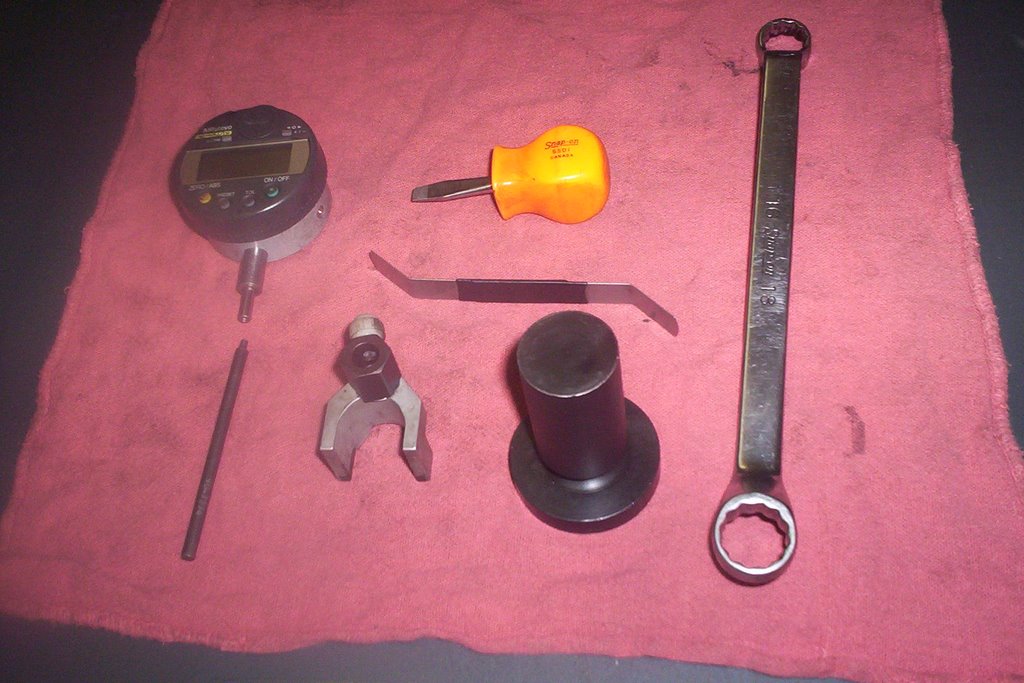
Here are the tools needed to perform the valve and injector adjustment:
Caterpillar Part #'s
*Dial Indicator # 1U-8869
*Contact Point # 9U-7274
*Feeler Guage # 123-4941
*16mm/18mm Drop Wrench # 128-8824
* Timing Guage Block # 9U-7269
Magnetic Base # 123-4940
Setting the valves and injectors is a preventive maintenance operation and should be done on a regular basis. Once you get through one setting it's a cakewalk the second time around. Below is the dataplate that tells you the timing specification for setting injectors.
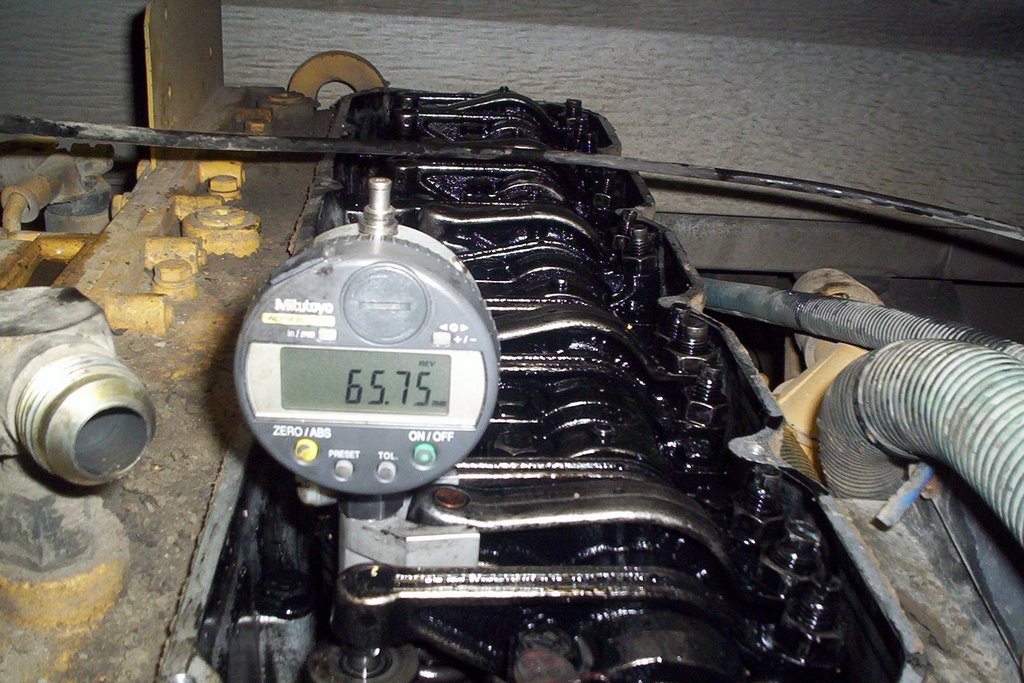
The dial indicator has to be pre-set so it reads 62.00 mm when placed on the timing guage block as shown below. These tools come with the complete Caterpillar tune-up kit with detailed instructions included.
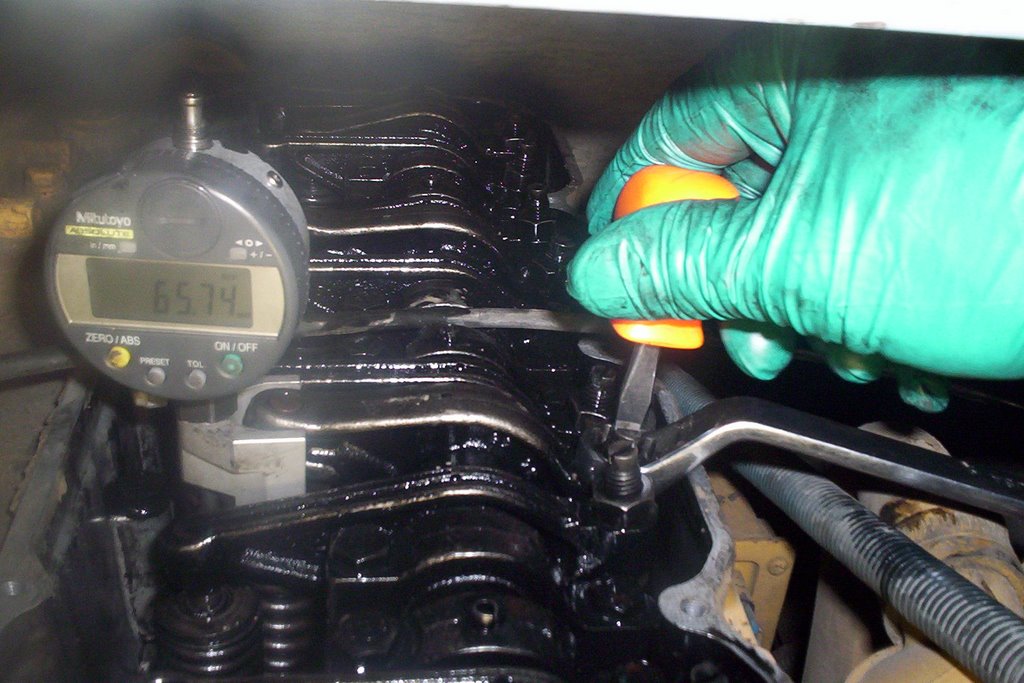
The first thing to do is rotate the engine over until # 6 cylinder valve rockers are rocking. Watch # 6 valve rockers as you are rotating the engine, keep turning the engine until the exhaust valve closes and the intake valve JUST starts to open. Stop there, # 1 cylinder is now on the Compression Stroke and ready for valve adjustment as well as the other designated injectors and valves. *Adjust 3-5-6 injectors to timing spec. / in this case 65.74 mm / + or - .020 mm
*Adjust 1-2-4 intake valves .015 in.
*Adjust 1-3-5 exhaust valves .025 in.
Rotate engine over 360 degrees and adjust the other remaining valves and injectors. # 6 cylinder is now on compression stroke since #1 and # 6 pistons are always at TDC [top dead center]together.
*Adjust 1-2-4 injectors
*Adjust 3-5-6 intake valves
*Adjust 2-4-6 exhaust valves
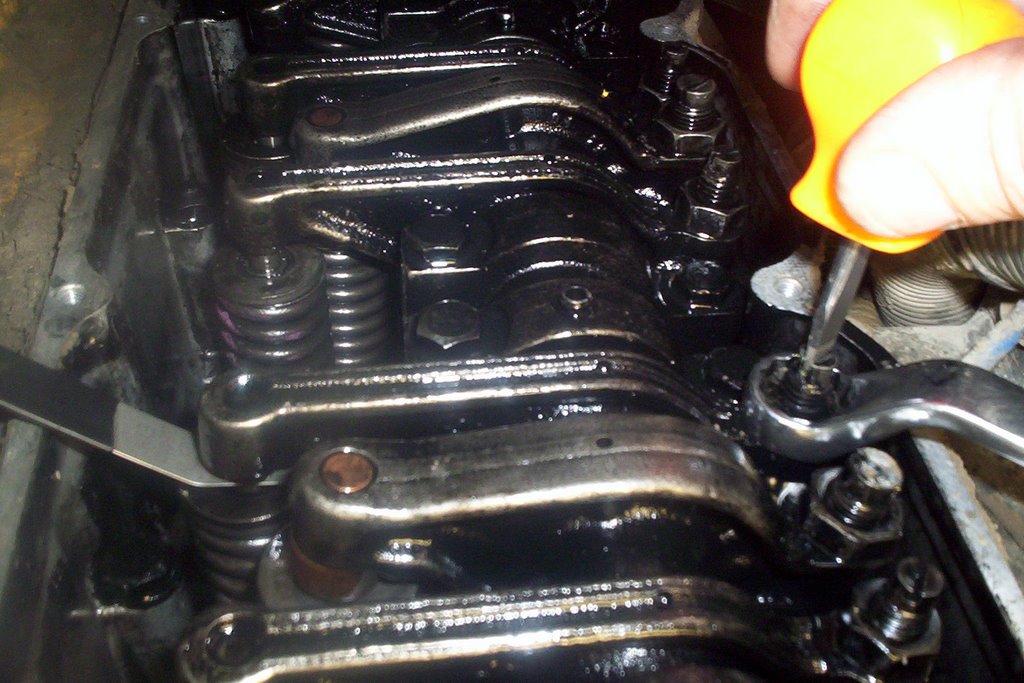
As you can see from the above picture the magnetic dial indicator holder sits on top of the injector. The dial indicator measures the distance from the top of the injector to the machined body surface at the bottom which must be set correctly. This dimension effects injection timing and can be adjusted at the injector rocker arm set screw.

I hope this post helps out all you Cat 3116 owners. The valve and injector adjustment is probably the most crucial as adjustment can change with normal wear and tear as your diesel engine racks up the mileage.
That's all for now, thanks for visiting and be sure to check back for more Diesel Mechanic Tips.
Wednesday, December 15, 2010
Bleeding Diesel Fuel System - Mercedes MBE 900 Engine
We learned the hard way & experienced troubles trying to prime the Mercedes MBE 900 Diesel Engine. It was a chore trying to get it started again after it ran out of fuel.Pressurizing the fuel tank and bleeding the system at the fuel lines was tedious and a crude method to say the least.
Most of these engines come from the factory with a quick coupler located at the fuel filter housing. The 2005 and earlier models have to be installed with the new coupler, a kit can be obtained from the Mercedes dealer.
We acquired the female quick coupler from the local dealer and added a hose along with a stainless steel pressure tank similar to a lawn fertilizer set up. There isn't a lot of pressure required to bleed the fuel system, all it takes is 5 p.s.i or better. There is a bleeding apparatus available that we are looking at picking up. I will re-post when it arrives and give it a test drive.
This tank has to be topped up with diesel and pumped continuously while a second person cranks over the engine. It works great and saves a lot of wear and tear on the starter!Note: there is a Technical Service Bulletin on the Thomas C2 School Bus models having a defective fuel gauge senderThe sender must be removed and tested with an ohm meter. We had some incidents on one of our C2 units running out of fuel prematurely.
Once you get this pressure tool all set up it will make removing the air from a Mercedes MBE 900 Engine fuel system much easier.
Thursday, December 02, 2010
Mercedes MBE 900 Diesel Engine - Changing Thermostats
Configuration: inline 6
Displacement: 7.2 Liters
(439 cu in)
Bore: 4.17 in (106 mm)
Stroke: 5.35 in (136 mm)
Weight: 1,362 lbs (618 kg)
Electronics: DDEC® VI
Compression Ratio: 18:1
The local Mercedes dealer recommended to replace thermostats and coolant every two years on the MBE 900. Coolant breaks down over time and becomes acidic chowing down on gaskets and engine parts. On a conventional and pusher bus this is an easy operation. Three bolts and upper rad hose is all it takes to get to the thermostats.
The two thermostats come with a split o-ring that fits around the edge of the stat and nestles nicely into the bore of the thermostat housing. Below is a short video of a Mercedes MBE 900 diesel engine idling in a pusher bus. These engines come with EGR and DPF (Diesel Particulate Filter) systems to control emissions. Check out how the emissions are controlled using these components Right Here.
Saturday, April 03, 2010
Deutz Diesel Engine Animation Video
The double overhead cam engineering shown in the video shows stroke by stroke what goes on in a internal combustion diesel engine. The main advantage using overhead cam technology is less moving parts, mainly... no pushrods
Mind you the timing chain and cam gears would have to be rock solid with the extra duties. When you think about it the size and length of the chain would be an advantage since there would be a larger surface in length to distribute overall wear and load.
Note the chain tensioner device on the side. I'm not sure how it monitors and adjusts the chain tension but definitely required.
Here's A Timeline on the Deutz Diesel Engine History
1864: N.A. Otto & Cie. is founded in Cologne, Germany.
1869: The company is renamed Langen, Otto & Roosen.
1872: Company is transformed into a public share company and is renamed Gasmotoren-Fabrik Deutz AG.
1921: Cooperation with Motorenfabrik Oberursel starts and name is changed to Motorenfabrik Deutz AG.
1930: Company merges with Maschinenbauanstalt Humboldt AG and Motorenfabrik Oberursel to become Humboldt-Deutzmotoren AG.
1938: The company is integrated into Peter Klöckner's conglomerate and renamed Klöckner-Humboldt-Deutz AG (KHD).
1953: KHD becomes independent again.
1992: KHD AG is transformed into a management holding company.
1997: The company is renamed Deutz AG.
Company Overview:
Deutz AG is one of Germany's leading manufacturers of diesel and gas engines for the global market. The Deutz product range includes liquid and air-cooled high-speed diesel and gas engines with a performance of four to 7.4 kilowatts (kW) which are used in cars, tractors, ships, turbines, compressors, and pumps, to name but a few. Deutz is the main supplier of diesel engines for Swedish auto maker Volvo AB.
The company's industrial plant business division is organized under the umbrella of KHD Humboldt Wedag and builds industrial plants for the cement, mining, and aluminum industry. Deutz has sales and service offices all around the world. Deutsche Bank owns a 25 percent share in Deutz, while Volvo holds a ten percent stake.
That's quite a history on a diesel engine that's been around for so long and really accentuates German technology.
Saturday, February 20, 2010
Biggest Diesel Engine In The World!
The fuel costs amaze me (data below) and being a 2 stroke...how loud is this engine and what do the higher rpms do to the life of the engine?
PISTON AND CONNECTING ROD

ENGINE BLOCK

The Wartsila-Sulzer RTA96-C turbocharged two-stroke diesel engine is the most powerful and most efficient prime-mover in the world today. The Aioi Works of Japan's Diesel United, Ltd built the first engines and is where some of these pictures were taken.
It is available in 6 through 14 cylinder versions, all are inline engines. These engines were designed primarily for very large container ships. Ship owners like a single engine/single propeller design and the new generation of larger container ships needed a bigger engine to propel them.
The cylinder bore is just under 38" and the stroke is just over 98". Each cylinder displaces 111,143 cubic inches (1820 liters) and produces 7780 horsepower. Total displacement comes out to 1,556,002 cubic inches (25,480 liters) for the fourteen cylinder version.
Some facts on the 14 cylinder version:
Total engine weight: 2300 tons (The crankshaft alone weighs 300 tons.)
Length: 89 feet
Height: 44 feet
Maximum power: 108,920 hp at 102 rpm
Maximum torque: 5,608,312 lb/ft at 102rpm
Fuel consumption at maximum power is 0.278 lbs per hp per hour (Brake Specific Fuel Consumption). Fuel consumption at maximum economy is 0.260 lbs/hp/hour. At maximum economy the engine exceeds 50% thermal efficiency. That is, more than 50% of the energy in the fuel in converted to motion.
For comparison, most automotive and small aircraft engines have BSFC figures in the 0.40-0.60 lbs/hp/hr range and 25-30% thermal efficiency range.
Even at its most efficient power setting, the big 14 consumes 1,660 gallons of heavy fuel oil per hour.
This an amazing diesel engine and I wonder if they will ever go hybrid? Just Kidding...I don't think they would room for the battery pack. It would be one heck of an accomplishment. Japanese technology reigns supreme once again. It makes me wonder why they can build these huge machines in their own country and HOW A CRUISE LINE run them without going broke with the fuel costs & diesel engine maintenance. I would guess ticket sales would have to be adjusted UP (most times) in accordance with the price of fuel.
Here is an excellent video explaining how a 2 stroke Gas Engine works the principle being the same with diesel engines.
Check out this Detroit 8V 71 2 Stroke Diesel Running (Takes me back to the non emmission control days...where there's smoke there's a screamin' Jimmy!). Having 2 strokes instead of 4 makes it easy to understand how much higher the RPMs are. If I were these guys I would have rigged up a decent engine stand.
The Wartsila-Sulzer RTA96-C Homepage DIESEL ENGINE
Monday, January 11, 2010
DT466 Diesel Engine Is The Best Performer In Cold Weather
Not only can you rebuild them in frame for a fraction of the cost of a new diesel engine but the life expectancy of a well maintained DT466 is in the range of 300 to 400 thousand kilometers. This is mainly in school buses since the maintenance program is very strict in most districts.
That's not to go without saying that any highway or off road DT466 diesel engine can reach these numbers as well. It was a sad day when International stopped making these engines.
With the electronic age came the DT466E and I'm impressed with them as well but you have to treat them with a little more sensitivity when firing them up in cold weather.
You could have a can of diesel engine starting fluid commonly known as ether and give the intake a quick shot and before you can say "thank you lord Jesus" that puppy would be smoking away and ready to go to work like a loyal bird dog!
OK here is my last plug of the day.
If you're looking for a used school bus for sale then I highly recommend going for a bus that is equipped with a DT466 diesel engine.
Check out this video: A 1989 International S1800 with a DT466 diesel engine doing a cold start up in 10 to 15 degree (Fahrenheit) weather
Friday, August 07, 2009
Diesel & Gasoline Working Together?
The Wartsila-Sulzer RTA96-C turbocharged two-stroke diesel engine pictured has a thermal efficiency of 50% (the best in the world). There is new research going on in the University of Wisconsin, Madison that got 53% thermal efficiency out of a Cat Diesel Engine.I just read the article about this new technology mixing gasoline and diesel into a diesel engine. This system increases the thermal efficiency by 20% but reduces the temperature in the combustion chamber by 40% creating less unburned fuel out the tail pipe.
The mix would be computer controlled and since there would be less energy loss through heat transfer, improved combustion would cause an increase in power with less emissions.
The computer age has allowed scientists and researchers to stretch the resources we have right now to the limit in a very efficient way. Without computer programming, monitoring, and adjusting operating parameters this new technical solution for decreasing vehicle emissions would not be possible.
I hope you found this Mechanic Information interesting...