Cummins ISB Diesel Engine Running from John Whelan on Vimeo.
Just listen to that baby purr...doesn't it sound great? Cummins has won the "who makes the best medium diesel engine contest". These engines excel way beyond all others on the market. Caterpillar and Navistar collaborated with the MaxxForce design using HEUI injection and it could not keep up with emissions and those of us who still operate them are paying through the nose with repairs and labor to keep them on the road. Production has ceased for all MaxxForce diesel engines in the medium duty industry along with the latest shut down of the 9 and 10 models.
Mercedes MBE 900 engine manufacturing shut down years ago because of the same reason not being able to pass the emission standards. We still have several of these engines running in our fleet and are kept on our toes dealing with emission issues. They have a sturdy block and top end but could never keep the engine clean enough to run the way it should have in the first place. Soot and ash is everywhere causing constant driveability problems.
More reasons why my top pick is the Cummins ISB. It has the SCR system developed by Cummins engineers to reduce emissions down to Hydrogen and water. In other words zero levels of harmful oxides of nitrogen that pump directly out of diesel engine combustion chambers. Cummins uses diesel exhaust fluid to inject into a catalyst combined with the original diesel particulate filter design forcing bad emissions to it's knees. Our fleet will be nothing but Cummins ISB from here on in. There will be no guinea pig testing with us anymore with new diesel engine designs that salesman push with their over-enthusiastic promotions.
Sorry guys that's not going to work in our fleet. We've got our hands full trying to keep up with inferior diesel engines that fail constantly and pick away at our operating budget. It's easy to talk the talk but we are the ones that end up pulling our hair out for years. I would like to thank Cummins for designing the ISB diesel engine with the end user in mind. Everything that has to be serviced is easy to reach... your software is excellent and down time is minimal. Think red...Cummins red if you're thinking about buying a truck or a bus. You will keep a lot more cash in your wallet and you'll spend a lot more time on the road.
Showing posts sorted by relevance for query cummins isb. Sort by date Show all posts
Showing posts sorted by relevance for query cummins isb. Sort by date Show all posts
Monday, December 04, 2017


Friday, November 05, 2010
Cummins ISB Engine
For emission requirements the Cummins ISB engine was re-engineered to a 24 valve system. the acronym ISB stands for Interact System B with a Bosch VP44 rotary injection pump which was used until 2003. After 2003 it had an upgrade to a Bosch common rail high pressure injection system.
Torque was increased to 610 lb ft giving it higher low speed torque and a increased performance output compared to a V8 diesel in the medium duty truck industry.
5.9L Cummins ISB Engine Specifications:
The displacement is 5.9 Liters (359 cu. in.) with an inline 6 design. The firing order is 1-5-3-6-2-4 with a compression ratio of 16.3:1 and a high output version ratio of 17.2:1. Direct Injection started in 1998 which changed to common rail injection in 2003. The torque is 460 - 610 lb-ft @ 1,600 RPM with Horsepower rated at 235 - 325 HP @ 2,900 RPM.
From a Mechanic standpoint I really like the Cummins ISB engine and as you can hear from the video it really purrs nicely (After the compressor kicks out). The biggest problem we've had with the 2009 models is a minor exhaust manifold leak on a few of them and one compressor failure. In a fleet of buses that is an excellent record.
Wednesday, December 14, 2005
Cummins isb diesel motors
CUMMINS ISB Diesel Motors - Head Gasket Replacement Cont...
Once the CUMMINS ISB diesel engine cylinder head is removed we must clean and inspect it. This particular engine is only 5 years old so there wasn't anything with the head that required attention. Once the head is cleaned up the top of the block & cylinders need attending to, the crosshatch pattern is still visible in the cylinders which tells us there's very little wear on the cylinder walls.
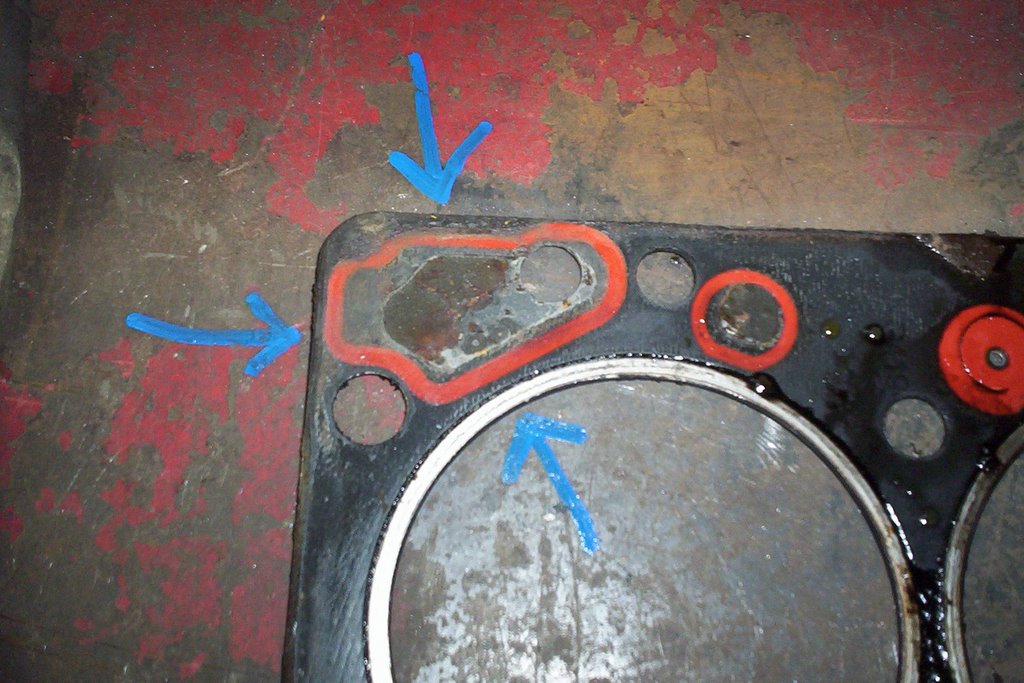
The old cylinder head gasket shows us exactly where the problem area was, the deterioration around the right front corner is easy to spot. The local CUMMINS dealer told us that this particular diesel engine model leaks in the same place, just under the thermostat housing. Even if there is evidence of a minor stain the problem will escalate eventually.
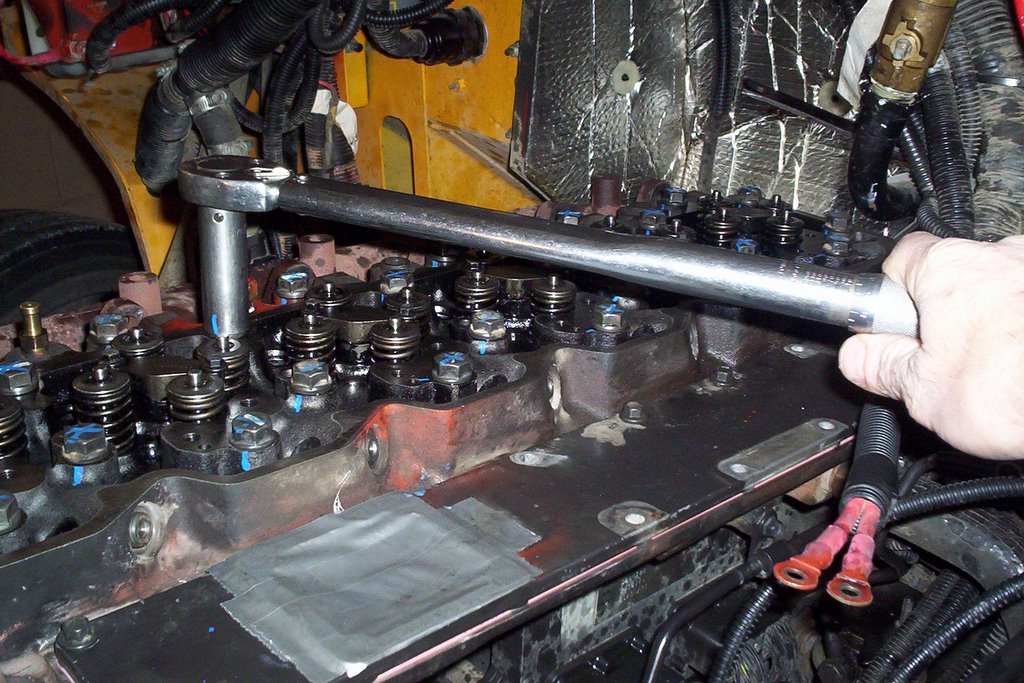
We now install the new gasket and head [very carefully] torque all the head bolts to 59 ft. lbs. / recheck. torque again to 77 ft. lbs. / recheck, lastly rotate each head bolt another 90 degrees. The torque pattern is the same as ever for any head component, start from the middle and move in a circular pattern out to each end of the head. DONE!
NOTE: CUMMINS diesel engine head bolts are all tightened using the 'TORQUE & TURN' method, the angle markings on top of the bolt head will confirm this. After the final torque the head bolts are rotated another 90 degrees.
MORE on my next post.... Cummins isb diesel motors
Monday, November 22, 2010
Cummins ISB Troubleshooting Coolant In The Lubricating Oil

However no diesel is perfect so follow me through this quick troubleshooting procedure if you experience coolant in the lubricating oil.
1. The first thing to check is the lubricating oil cooler. The engine oil is cooled by way of the coolant running through a sealed core inside the housing. If it develops a leak you're stuck with coolant getting in the oil. The coolant core can be tested and replaced.
2. The next possibility is the air compressor cylinder head is cracked, has a defective casting (porous) or the head gasket is defective. This is an overlooked cause, the cooling system from the engine is connected to the compressor running through the compressor cyl. head.
3. If your cummins
 isb engine came with an aftercooler it can be pressure tested to see if there is any problems with the inner core leaking.
 4. The engine cylinder head is the next possibility with a leaking core or defective expansion plugs. The head must be checked out with a pressure test and magniflux test to find any leaks or cracks.
5. Last but not least is the worst case scenario, the cylinder block. If it's cracked or porous you may be looking for a replacement block or reman (remanufactured) engine.
These are mechanic tips that you can use to get you started finding the cause of coolant in your engine oil.
CHECK OUT ALL MY PREVIOUS POSTS ON THE CUMMINS ISB ENGINE
Wednesday, March 21, 2012
Cummins ISB Diesel Engine Assembly Video - Animated
The Cummins ISB Diesel Engine is dependable and since we run several in our fleet I can stand behind that statement. They came from the factory perfectly compatible to the transmission and we've had very few problems. The exhaust gaskets and connector on the manifold, a couple of failed water pumps along with some minor codes are all that we've had to deal with since 2009.
These problems have all been covered by warranty so it's a win win situation. One of our codes involved the water in fuel light coming on and going off intermittently. The solution has turned out to be the 'Racor water in fuel sensor' on the primary fuel filter.
Have a look at the animated video showing in detail the assembly process of this engine. Who needs a manual, you can pause the video anytime as you go along. All you need is the torque specs.
Cummins ISB Diesel Engine Video
These problems have all been covered by warranty so it's a win win situation. One of our codes involved the water in fuel light coming on and going off intermittently. The solution has turned out to be the 'Racor water in fuel sensor' on the primary fuel filter.
Have a look at the animated video showing in detail the assembly process of this engine. Who needs a manual, you can pause the video anytime as you go along. All you need is the torque specs.
Cummins ISB Diesel Engine Video
Saturday, December 17, 2005
Cummins isb Diesel Motors
CUMMINS ISB Diesel Motors - Head Gasket Completion
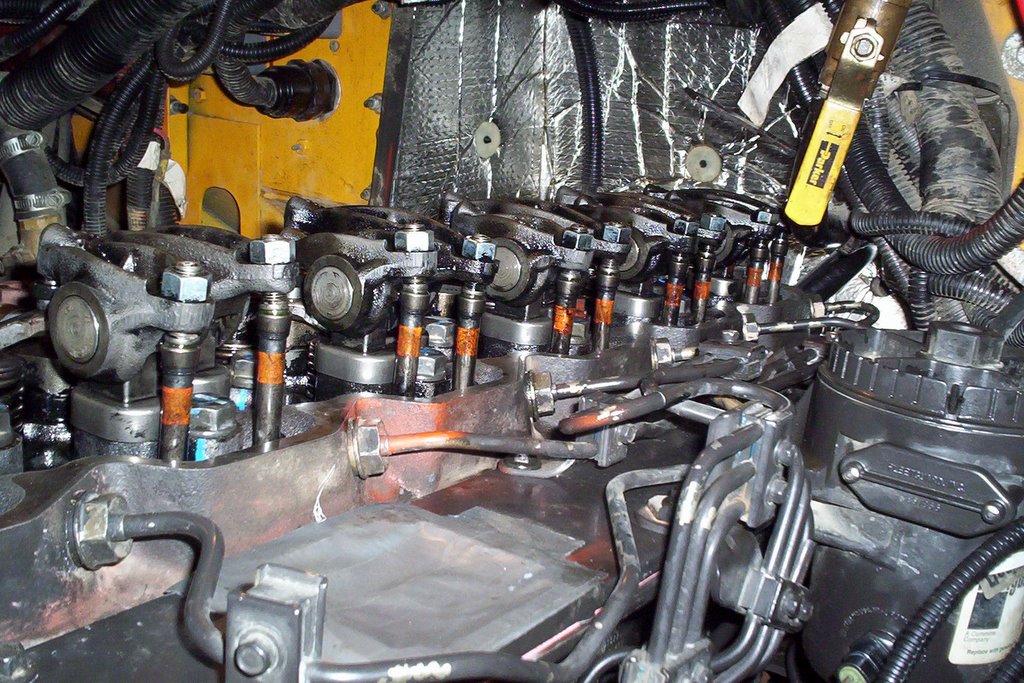
So now that the head is installed and torqued the accessories can be reassembled on our diesel engine. The fuel line fittings have to be torqued to specs. 28 ft. lbs. for the head fittings and 212 in. lbs. at the injection pump.
The crossheads, pushrods and rocker assemblies can be installed and the rocker retaining bolts must be torqued to 27 ft. lbs.

VALVE ADJUSTMENT
Using the rocker method:
Rotate the engine until #6 valves are rocking meaning the exhaust valve is just closing and the intake valve is just starting to open. Stop rotating the engine when the intake valve JUST starts to move. The engine is on #1 TDC Compression stroke.
Intake Valve Clearance: .010 Exhaust Valve Clearance: .020
ADJUST #1 #2 #4 Intake valves #1 #3 #5 Exhaust Valves
ROTATE ENGINE 360 DEGREES
ADJUST #3 #5 #6 Intake Valves #2 #4 #6 Exhaust Valves
Reassembly from here is straight forward except for bleeding the fuel system which requires loosening the fuel return line [upper] fitting on the right side of the fuel filter and cranking over the engine. That's it for now on Cummins isb diesel motors.
Tuesday, December 13, 2005
Cummins isb diesel motors
CUMMINS ISB DIESEL MOTORS- Replacing The Head Gasket
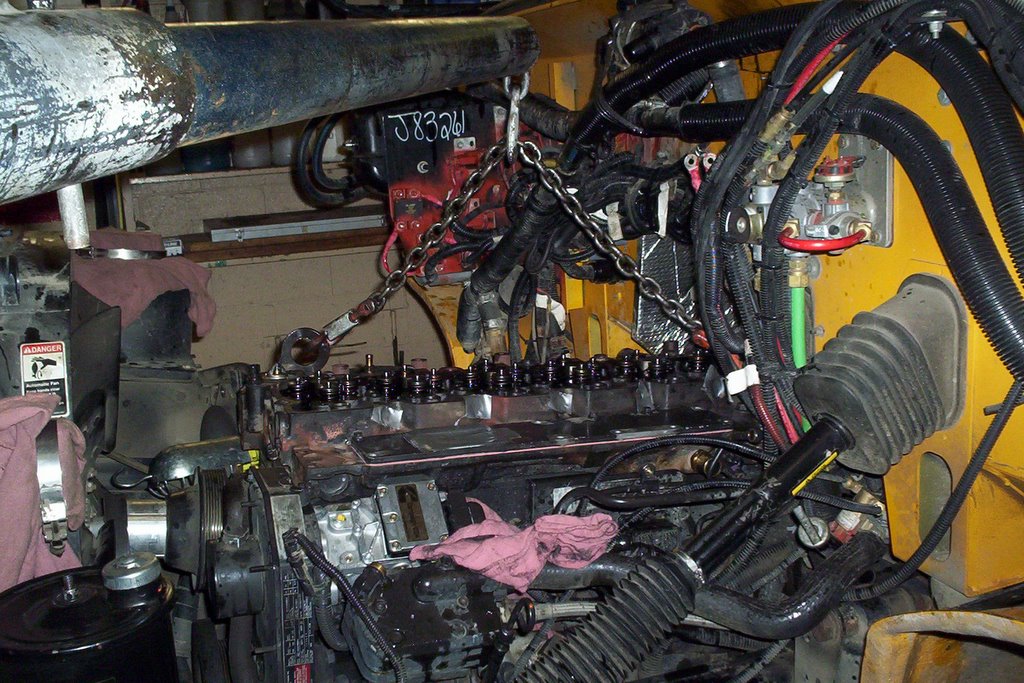
Replacing the head gasket is required on one of our Freightliner Conventional School Buses. The leak was minor, just under the thermostat housing but it won't fix itself so it's time to remove the cylinder head.
Once the piping,sensor connectors, hoses and injection lines are removed [coolant drained] the manifolds can be removed along with the head bolts. The injectors may be left in the head but care must be taken not to lay head down flat on the bench, this will damage the injector tips $$$$!
This part of the operation does not require TLC because we'll be replacing all the gaskets anyways.
To Be Continued..... Cummins isb diesel motors
Friday, December 05, 2014
Cummins Diesel Engine Training
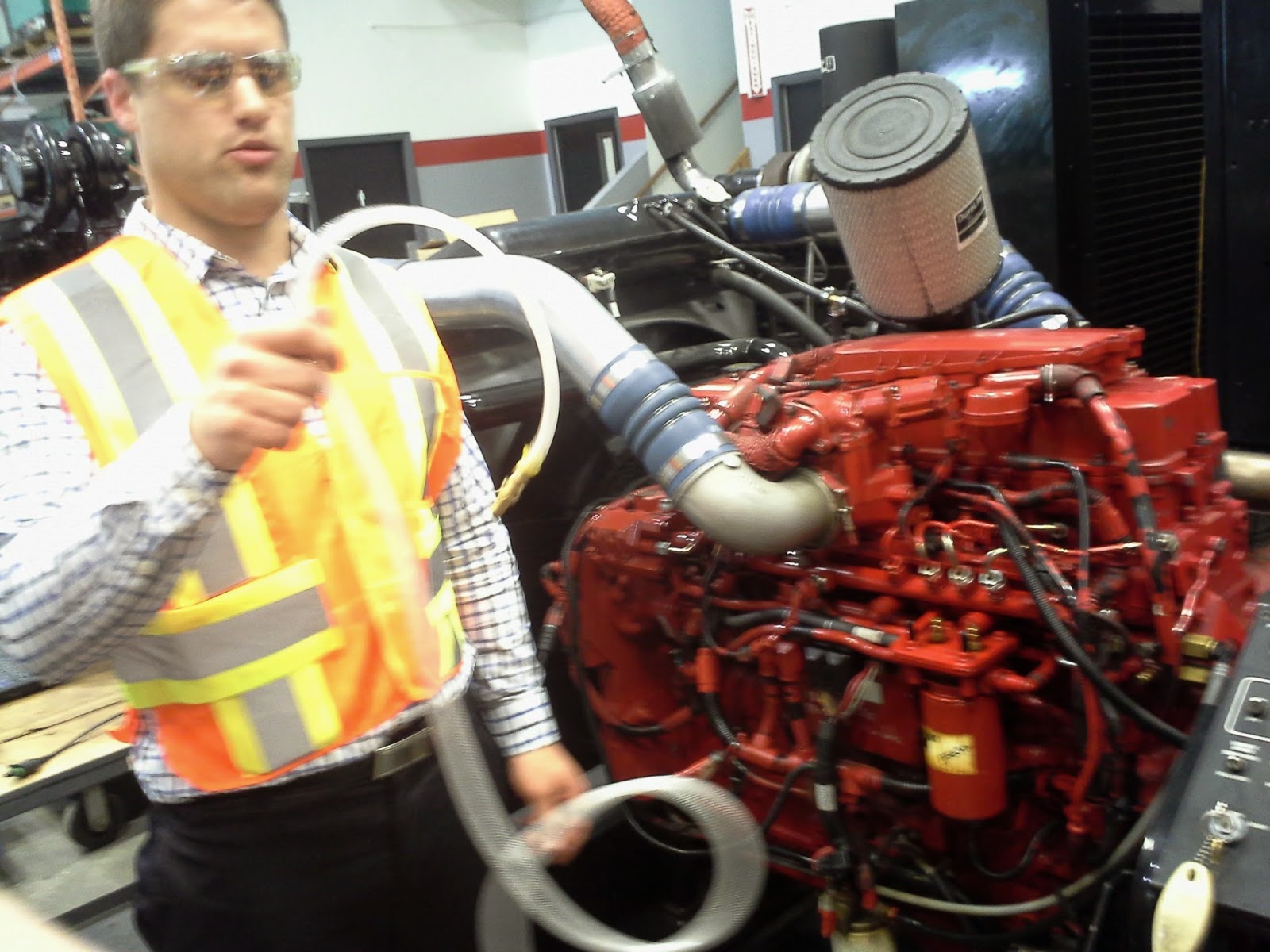

They have designed their own emission system including selective catalytic reduction and DPF (diesel particulate filter). Getting the emission levels down to EPA levels is a huge challenge. Cummins is reducing 90% of harmful exhaust out of the pipe. We own 9 of the ISBs and getting 10 more next year.
The support from our local dealer is very good which was one of the factors we looked at but I know even if the support wasn't there this would have been the engine of choice regardless. Having 'Insite Lite' software is a "must have" and without it you're sunk. Throwing parts at a problem and guessing what's wrong will cost you a ton of cash.
Another part of the ISB is the VGT (variable geometry turbocharger). Providing boost pressure for engine power is only one of the uses for this component. It also serves as the exhaust brake and helps heat up the engine during a parked regeneration. The angle of the turbo changes to cause the restriction needed.
Not only did we have classroom training but also went out and did a lot of hands on training using the Insite Lite software. The tests you can run with this software is endless. Gone are the days when you had to crack an injection line to look for a miss. Now it's all on the software with the click of a button.
For technical information there is Quickserve Online where you can find parts and manuals to help out with repairs. A manual is essential and without it you are taking a chance of screwing up the job. Information is like gold to a mechanic having the proper schematics, torque specs and step by step instructions.
I recommend anyone working steady on the ISB 6.7 or any Cummins engine needs to go get a Cummins training refresher. There you can ask questions and get the right training so you can dive into any repair with confidence. These days without a laptop on your toolbox with the proper software is like living in the stone age.
Saturday, April 26, 2008
Avoiding Cummins Engine Repairs With Regular Tune-ups.
 We recently had a Cummins Diesel Engine with a power complaint. One adjustment that gets overlooked is valve adjustment. This particular engine gained substantial power after adjusting the valves which required an average of 1/4 of a turn to meet specs. So this simple tune-up procedure should never be overlooked and must be carried out on regular basis.
The following is a valve adjustment on a Cummins ISB Diesel Engine: Valve adjustment on a Cummins Engine Repair is the final step. Engine position is very important because the intake and exhaust valves must be in the closed position.
Rotate the engine clockwise [looking from the front] until #6 cylinder rocker arms are both rocking. When you're on the correct stroke the exhaust valve will be moving into the closed position, then once it closes keep rotating the engine until the intake valve JUST starts to open. You are now on #1 Compression Stroke & ready to adjust 1/2 of the engine valves.Note: The crossheads pictured here on top of the valve stems [#5 & #6 Cyl] are located with the elongated contact surface towards the exhaust manifold. The Rocker arms are held down on aluminum cradles with one retaining bolt and torqued to 27 ft. lbs.
 Cummins 24 Valve Turbo Diesel Valve Adjustment Specs.
With the Engine on #1 Compression Stroke.
*Adjust #1 #2 #4 Intake Valves to .010 inch.
*Adjust #1 #3 #5 Exhaust Valves to .020 inch.
*Rotate Engine One Full Turn. #1 Cylinder Valves will rock like #6 did previously positioning the engine on #6 Compression Stroke.
*Adjust #3 #5 #6 Intake Valves.
*Adjust #2 #4 #6 Exhaust Valves.
I hope this mechanic information has helped you: It's not hard to adjust valves on a Cummins 24 Valve Turbo Diesel once you get the hang of it. All you have to know is how to position the engine correctly, the valve settings and some basic tools. That's it for now on Cummins Engine Repair.
Recommended: Diesel Engine Repair Manuals

Friday, March 05, 2010
The Cummins Diesel Engine AfterTreatment System
Cummins Diesel Engines have developed an after-treatment system that is very compact and easy to maintain. The only requirement is to have Diesel Exhaust Fluid available to add to the holding tank which is supplied by the Original Equipment Manufacturer.
Take a look at an over view of this system. Our fleet will be getting into these systems since we're running Cummins ISB and ISC Diesel Engines. Technology never stops growing, the age of smoky and sooty old exhaust pipes have come to an end.
Frequently Asked Questions - Cummins Aftertreatment System
1) What makes up the Cummins Aftertreatment System?
There are four major components: Selective Catalytic Reduction (SCR) Catalyst, Decomposition Reactor, DEF Dosing Valve, Cummins Particulate Filter.
2) What is DEF (Diesel Exhaust Fluid)?
DEF is a 32.5% strength urea water solution.
3) How much DEF will be required?
DEF consumption is expected to be approximately 2% of fuel consumption dependent on vehicle operation – duty cycle, geography, ratings, etc.
4) What size DEF tank is required on a vehicle?
The vehicle manufacturer/OEM will determine exact tank size and location on the vehicle. However, Cummins will be providing installation recommendations to the OEMs on tank size selections.
For example, in Europe, vehicle SCR tank sizes are typically 15 – 20 gallons.
5) What happens if the vehicle runs out of DEF?
Vehicles in 2010 that will use DEF will have two indicators on the dash that will alert the driver to quantity of DEF on board. One, there will be a new DEF gauge very similar to a fuel gauge today that will indicate level of DEF (i.e. full, half, quarter, etc.) Second, there will be a new DEF low level warning lamp that will illuminate when less than 10% of DEF is in the tank.
If the vehicle is operated such that one would run completely out of DEF the vehicle will not be shut down; however, power will be reduced enough to encourage the operator to refill the DEF tank. Once the tank has been refilled the engine will resume normal power levels.Mechanic Information to live by...
Take a look at an over view of this system. Our fleet will be getting into these systems since we're running Cummins ISB and ISC Diesel Engines. Technology never stops growing, the age of smoky and sooty old exhaust pipes have come to an end.
Frequently Asked Questions - Cummins Aftertreatment System
1) What makes up the Cummins Aftertreatment System?
There are four major components: Selective Catalytic Reduction (SCR) Catalyst, Decomposition Reactor, DEF Dosing Valve, Cummins Particulate Filter.
2) What is DEF (Diesel Exhaust Fluid)?
DEF is a 32.5% strength urea water solution.
3) How much DEF will be required?
DEF consumption is expected to be approximately 2% of fuel consumption dependent on vehicle operation – duty cycle, geography, ratings, etc.
4) What size DEF tank is required on a vehicle?
The vehicle manufacturer/OEM will determine exact tank size and location on the vehicle. However, Cummins will be providing installation recommendations to the OEMs on tank size selections.
For example, in Europe, vehicle SCR tank sizes are typically 15 – 20 gallons.
5) What happens if the vehicle runs out of DEF?
Vehicles in 2010 that will use DEF will have two indicators on the dash that will alert the driver to quantity of DEF on board. One, there will be a new DEF gauge very similar to a fuel gauge today that will indicate level of DEF (i.e. full, half, quarter, etc.) Second, there will be a new DEF low level warning lamp that will illuminate when less than 10% of DEF is in the tank.
If the vehicle is operated such that one would run completely out of DEF the vehicle will not be shut down; however, power will be reduced enough to encourage the operator to refill the DEF tank. Once the tank has been refilled the engine will resume normal power levels.Mechanic Information to live by...
Sunday, January 13, 2008
Cummins Engine Repair - ISB Model
 Cummins Engine Repair on a 2002 Thomas Freightliner School Bus. The head gasket was leaking coolant from the right front corner. The first step is to unhook the battery and drain the coolant.
The Turbocharger [pictured] can be removed as a complete assembly attached to the exhaust manifold. The fuel lines are removed from the opposite side.
 The Cummins 24 valve turbo diesel has 2 intake valves and 2 exhaust valves for each cylinder. The parts displayed here have been cleaned and inspected for pitting, hard surface wear and corrosion [head bolts]. Head bolts are measured for length, with a special guage provided by Cummins [usually comes with the head gasket kit].
 The cylinder head itself weighs approxiamately 80 lbs. [3 Mechanics removed the head off the block manually and it's a clumsy operation!]
Here I'm using the hydraulic hoist to install the head, the only problem we encountered was the reach was not long enough on the hoist boom so I removed the front wheel to enable rolling the hoist into the engine compartment further. [An overhead hoist would be perfect for this job!]
 Cummins Engine Repair involves cleaning and inspecting, especially when it comes to the block surface. Look for any cylinder scoring and cracks then run a straight edge on the block surface where only a few thousands of an inch wear is allowed. Use a .003 in. feeler guage to check the block wear.
 Removing the injectors is easy once the fuel connector tubes inside the head are removed [Below]. The injectors have hold downs on top that have 2 fasteners, when removed the injector has a threaded hole on top that can be used to pull the injector out which is held in by an o-ring.
NOTE: Remove injectors before removing cylinder head, the injector tips protrude past the head surface.
 The fuel connectors in the Cummins 24 valve turbo diesel have an o-ring seal and connect the fuel between the fuel injector lines and the injectors. They are tapered and have a machine fit into the injector body. The injector hold downs only install one way and index the injector in the head bore so the connector tube aligns with the injector.
I hope this basic overview has helped you get more aquainted with Cummins Engine Repair
More To Come!
Recommended: Diesel Engine Repair Manuals
Saturday, June 20, 2015
Cummins ISC Diesel Engine CAPS Failure
Cummins CAPS Assembly Repair from John Whelan on Vimeo.
This Cummins ISC diesel engine is in a 1999 Thomas pusher school bus. The engine died suddenly and eventually we found the drive failed in the CAPS pump assembly. Luckily the fuel injection shop we deal with had a core in the back room. We got lucky because the replacement of the pump assembly is around 4,000 dollars.
Most of the ISC diesel engines in our fleet have required a new pump. What happens is multiple engine codes that don't go away. There's a lot going on in the CAPS assy. It develops and controls the high pressure fuel that is distributed at the right time to each injector.
Running at 250 horsepower they are a great engine well suited for a school bus fleet. Other failures were injectors but not very often. The crank and cam sensors act up along with fuel leaks at the electric fuel pump. Our fleet only has 3 of these buses left and they are standing up very well for being thirteen years old.
The fuel pressure sensor in the CAPS accumulator was a regular failure through the years. Cummins did come up with a update on the sensor along with a replacement harness. It only takes 10 minutes to replace the sensor. I personally think Cummins has always been the leader in medium duty diesel engines.
I was an International DT466 fan for years until the emission and electronic version came around. Mechanical fuel injection can not keep up to emission guidelines and the old DT had to be scrapped. They were the best fleet diesel back in it's day but sometimes good things have to come to an end.
At present Cummins has the ISB which runs on DEF (diesel exhaust fluid) and besides the extra maintenance they are the most reliable engines in our fleet. They run seamlessly with the Allison automatic transmissions and the operators really like them for power and we like them for reliability.
Please comment and share this post and thanks for visiting my blog.
Saturday, January 26, 2008
Cummins Engine Repair-Adjusting Valves ISB
 Valve adjustment on a Cummins Engine Repair is the final step. Engine position is very important because the intake and exhaust valves must be in the closed position.
Note: The crossheads pictured here on top of the valve stems [#5 & #6 Cyl] are located with the elongated contact surface towards the exhaust manifold. The Rocker arms are held down on aluminum cradles with one retaining bolt and torqued to 27 ft. lbs.
Cummins 24 Valve Turbo Diesel Valve Adjustment Specs.With the Engine on #1 Compression Stroke.
*Adjust #1 #2 #4 Intake Valves to .010 inch.
*Adjust #1 #3 #5 Exhaust Valves to .020 inch.
*Rotate Engine One Full Turn. #1 Cylinder Valves will rock like #6 did previously positioning the engine on #6 Compression Stroke.
*Adjust #3 #5 #6 Intake Valves.
*Adjust #2 #4 #6 Exhaust Valves.
It's not hard to adjust valves on a Cummins 24 Valve Turbo Diesel once you get the hang of it. All you have to know is how to position the engine correctly, the valve settings and some basic tools. That's it for now on Cummins Engine Repair.
Recommended: Diesel Engine Repair Manuals
Saturday, September 27, 2014
Diesel Engine Emissions A New Frontier In Preventive Maintenance

The diesel engine has always evolved through the decades but the challenge in the new millennium was to reduce soot and ash discharge levels out the tail pipe.
The catalytic muffler was the first on the scene along with ultra low sulfur diesel and low ash engine oil. The muffler transformed into the DPF diesel particulate filter which traps soot and then through an oxidation process remove harmful particulates from entering the atmosphere.
The very difficult problem for the engineers and the battle to stay within EPA specifications is costing Cummins, Mercedes and Navistar a lot of money in research and development. The progression to cooled exhaust gas recirculation worked for many years along with the DPF technology.
However the EGR by itself wasn't enough to keep up with environmental demands. Navistar this year will no longer supply diesel engines in the medium duty market. The EGR pictured above is out of a MaxxForce DT diesel engine. We have several of these engines in out fleet and this component needs regular maintenance or replacement at least once a year.
At the vary least removal and cleaning of the soot and ash buildup is necessary or the shaft that opens and closes the valve sticks and eventually causes the EGR valve to stay open which creates problems with power and take off ability. Every one of our fleet buses are checked for stuck EGR valves especially the older units.
Mercedes EGR valves have the same problem and eventually the electric motor that opens and closes the valve mechanism does not have enough strength to over come the soot covered shaft and valve assembly. At the end of this year Navistar medium duty diesel engines like the MaxxForce DT and MaxxForce 7 will not be manufactured any more.
The Cummins ISB will be taking over the field with it's own technology including the SCR (selective catalytic reduction) system that uses DEF diesel exhaust fluid to reduce emissions. They also have the VGT variable geometry turbocharger to increased heat to assist in the regen process that cooks out the soot build up in the emission system.
It's a heavy duty challenge to keep up with emission demands but when the going gets tough Cummins diesel engines get going. They have really excelled over other diesel engine manufacturers and went outside the box to over come the high demands from the EPA to reduce emissions levels to zero through out the transportation industry.
Thursday, April 19, 2012
Cummins 24 Valve Turbo Diesel Torquing Head bolts
Torquing Head Bolts on a Cummins 24 Valve Turbo Diesel Engine.
This is a video I posted years ago on Youtube. There was a lot of noise in the background and I just grabbed my torque wrench and went through the sequence. I apologize for the poor video quality but I get my point across :)
The Torque Pattern
Start from the middle of the head in a circular pattern outwards. Torque to 59 ft.lbs then 77 ft. lbs. check again at 77 ft.lbs. then finally another 90 degrees. Coat threads lightly with engine oil. This is a universal torque pattern that makes sense to apply to any type of diesel or gas engine.
Starting from the middle and moving outwards so the head is fastened down evenly. Cummins uses a system called torque and turn which accounts for the extra 90 degrees to finish off. The Cummins 24 valve turbo diesel (5.9 Liter or 359 cubic inches) is one of the most dependable engines in our fleet.
I must add that this diesel is an electronic model known as the ISB which stands for Interact System B.
Below are some extra Specs:
- Fuel System = Direct Injection
- 1998.5 - 2002: Electronically controlled Bosch VP44 rotary injection pump.
- 2003-2007: Bosch high pressure common rail injection.
- 235 - 325 HP @ 2,900 RPM
- 460 - 610 lb-ft @ 1,600 RPM
Please Comment and Share!
This is a video I posted years ago on Youtube. There was a lot of noise in the background and I just grabbed my torque wrench and went through the sequence. I apologize for the poor video quality but I get my point across :)
The Torque Pattern
Start from the middle of the head in a circular pattern outwards. Torque to 59 ft.lbs then 77 ft. lbs. check again at 77 ft.lbs. then finally another 90 degrees. Coat threads lightly with engine oil. This is a universal torque pattern that makes sense to apply to any type of diesel or gas engine.
Starting from the middle and moving outwards so the head is fastened down evenly. Cummins uses a system called torque and turn which accounts for the extra 90 degrees to finish off. The Cummins 24 valve turbo diesel (5.9 Liter or 359 cubic inches) is one of the most dependable engines in our fleet.
I must add that this diesel is an electronic model known as the ISB which stands for Interact System B.
Below are some extra Specs:
- Fuel System = Direct Injection
- 1998.5 - 2002: Electronically controlled Bosch VP44 rotary injection pump.
- 2003-2007: Bosch high pressure common rail injection.
- 235 - 325 HP @ 2,900 RPM
- 460 - 610 lb-ft @ 1,600 RPM
Please Comment and Share!
Tuesday, August 28, 2007
A typical road test in a Thomas School Bus, this unit has a Cummins ISB Model [electronic] Diesel Engine and when roadtesting it's always best to find a good grade to find any faults with performance.
Sometimes the transmission has to be considered if it's shifting poorly. If you're climbing a hill and the trans. upshifts too soon you'll start lugging the engine which feels like an engine power problem.
Monday, December 25, 2017
Mercedes MBE Diesel Engine Pusher School Bus
The cold start on this bus was perfect without any hold ups. It was plugged in and the batteries are obviously in good shape. Of course with most diesel engines the white smoke is normal with incomplete combustion going on. Heat from compression is low in this case so it takes a while for normal combustion temperatures to occur. The rule of thumb with diesel engines in my book is to put the engine to work as soon as you get normal oil pressure or at least make sure the high idle mode is on. Idling a diesel in cold weather is not a good practice because of the build up of carbon and related combustion byproducts that happen with cold starts.
These MBE 900 diesels are good solid engines except for the emissions which was adapted to the original block in 2007. The blocks can not be swapped from non emissions to these 2007 models because of added modules that were engineered to meet emission standards. I know this from experience we have a 2008 MBE that has a cracked block and no one can find me a bare block for it. There are plenty of non emission blocks around but nothing newer. The long block is available from the dealer but at a huge cost and a core charge that we would not get back due to the crack in the block.
When the warranty was up with these engines we were in for a lot of challenges. The engine codes were running away on us with daily occurrences with the EGR valves, DPF diesel particulate filter, EOS electrostatic oil separator along with boost and charge air codes that did not let up. Two of these pushers were sports run buses and almost every trip they would radio back and tell me the engine was coding. One saving grace was the ignition key could be cycled on and off which would reset the code until it came back again. But this would stress me out regardless being helpless with the bus so far away. One bus was 4 hours out of town and I spent hours trying to line up a service call to do a parked regen or else the bus was dead in the water.
Eventually these 2 bad boys were taken off of the sports run and we started using newer Cummins ISC diesel engines. The pressure was off and if you have read any of my other posts Cummins is my choice for a diesel engine medium duty ISB and ISC models. Yes they don't last forever there are quirks and failures but an extremely smaller percentage compared to other diesels on the road. Preventive maintenance had proven to extend down time and the extra cost is money well spent.
Subscribe to:
Posts
(
Atom
)